How much glycol do I add? Setting the right coolant concentration
Adding water or concentrate without a target concentration is how loops drift out of protection. See how to set a target, read the curve, and correct a charge.
THE SHORT ANSWER
What you need to know.
Work out the target concentration from your lowest real temperature and whether the loop must keep circulating, then adjust in measured steps and verify by measurement — never by adding fluid until the gauge looks right. Glycol concentration drives freezing point, boiling point, viscosity and inhibitor dose at the same time, so both over-dilution and over-concentration carry a cost. Use the property table for your exact product to convert a target into a percentage.
- The target comes from the application: start-up temperature and whether the loop must circulate decide freeze versus burst protection.
- Concentration moves several properties together, and the freezing-point curve peaks and then reverses — past the optimum, more glycol buys less protection.
- Correct by measured increments and re-measure. A refractometer or hydrometer reads concentration, not protection.
The two-word answer nobody wants
The question arrives in a specific form: "How much glycol should I add?" The honest answer is that the number depends on what you are trying to achieve — and that is not the same as the number on the drum.
Two things determine it. The lowest temperature the loop will actually see, and whether the system has to circulate at that temperature or merely survive it. Those give you different targets, because freeze protection and burst protection are not the same requirement — a distinction covered in glycol freezing point versus burst point.
Everything else follows from the property table for your product.
Read the curve before you pick a number
Concentration-dependent tables are published for the dilutable families. The LM-4 series is a useful example, because it shows how freezing point, boiling point, density and viscosity all move together:
| Concentration (wt%) | Freezing point | Viscosity (measured at) |
|---|---|---|
| 20 | −8 °C | 2.45 cP at 5 °C |
| 30 | −15 °C | 5.49 cP at −5 °C |
| 40 | −23 °C | 12.37 cP at −15 °C |
| 50 | −35 °C | 32.90 cP at −25 °C |
| 80 | below −45 °C | 70.20 cP at −20 °C |
| 90 | −29.5 °C | 65.03 cP at −10 °C |
Plotted across the full range, the shape is easier to see than in the row-by-row figures:
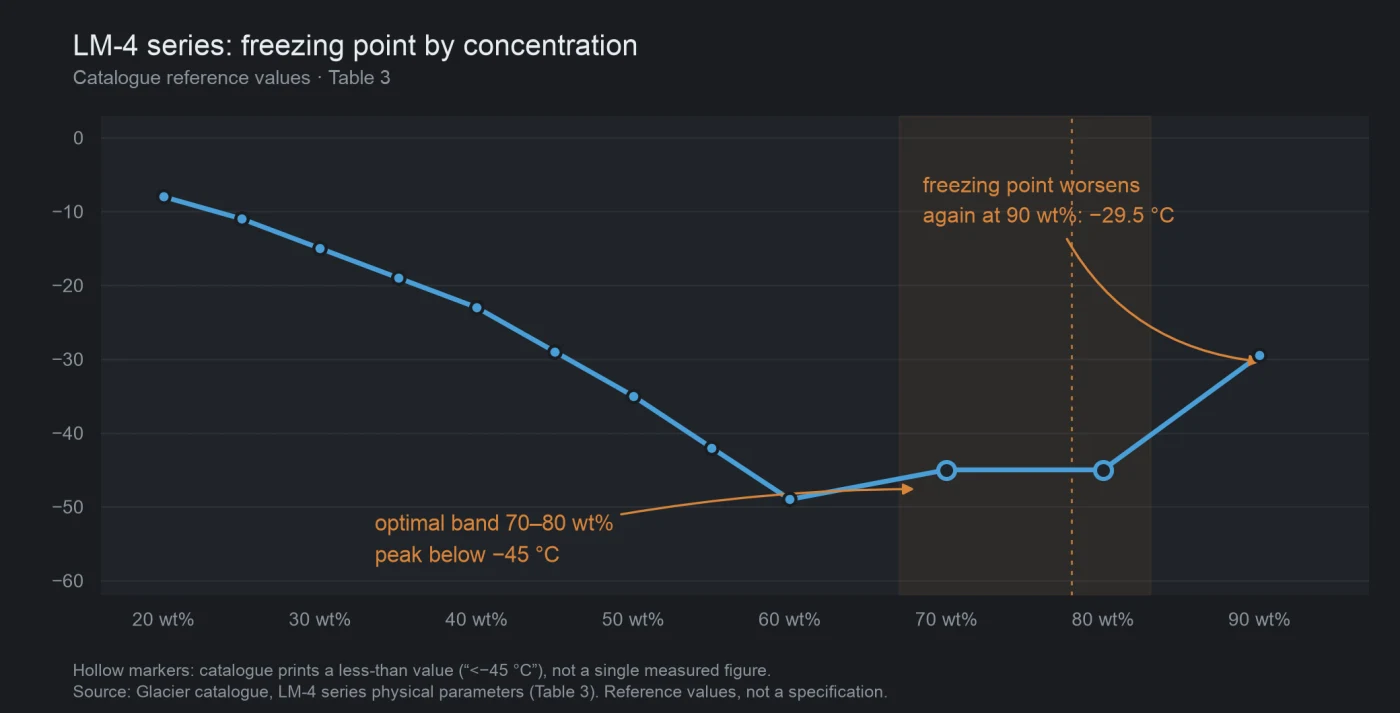
Read the curve carefully. The freezing point improves steadily as concentration rises — and then reverses. At 90 wt% the freezing point is −29.5 °C, worse than the sub-−45 °C figure at 80 wt%. More glycol does not keep buying protection; past a point it costs protection.
The viscosity column behaves differently again. Each figure is a measurement at the temperature shown in brackets, and those temperatures drop as concentration rises, so the column is reflecting both effects at once. The practical point is that the concentration giving you the freezing margin you need also sets the pump duty you will pay for — the trade-off covered in why pumping energy decides a low-temperature coolant.
These are reference values. They describe the product at stated concentrations under stated test conditions, not your loop. The right number for your system is the one that clears your lowest temperature with margin while keeping the fluid pumpable — and the pumpable requirement is frequently the binding constraint.
Why over-concentration is a real cost
There is a persistent instinct that "a bit stronger" is safer. In a glycol loop it is a trade, not a free upgrade — and past a point it is a straightforward loss.
Two things go wrong. The viscosity rises sharply, so pressure drop climbs and the circulator works harder for the same heat removal; a charge mixed heavier than the application needs spends energy every hour it runs. And the freezing point eventually stops improving and starts getting worse. In the LM-4 table above, 80 wt% gives a freezing point below −45 °C while 90 wt% gives −29.5 °C. The curve peaks and turns.
Under-concentration carries the opposite risk, with a worse failure mode: the loop loses freeze margin, and the inhibitor is under-dosed for the wetted area it has to protect. A fluid can be chemically correct and still be protecting nothing because there is not enough of it in the water.
The target is a band, not a direction.
Correct by measured steps
The procedure is short, and the discipline is in the measurement.
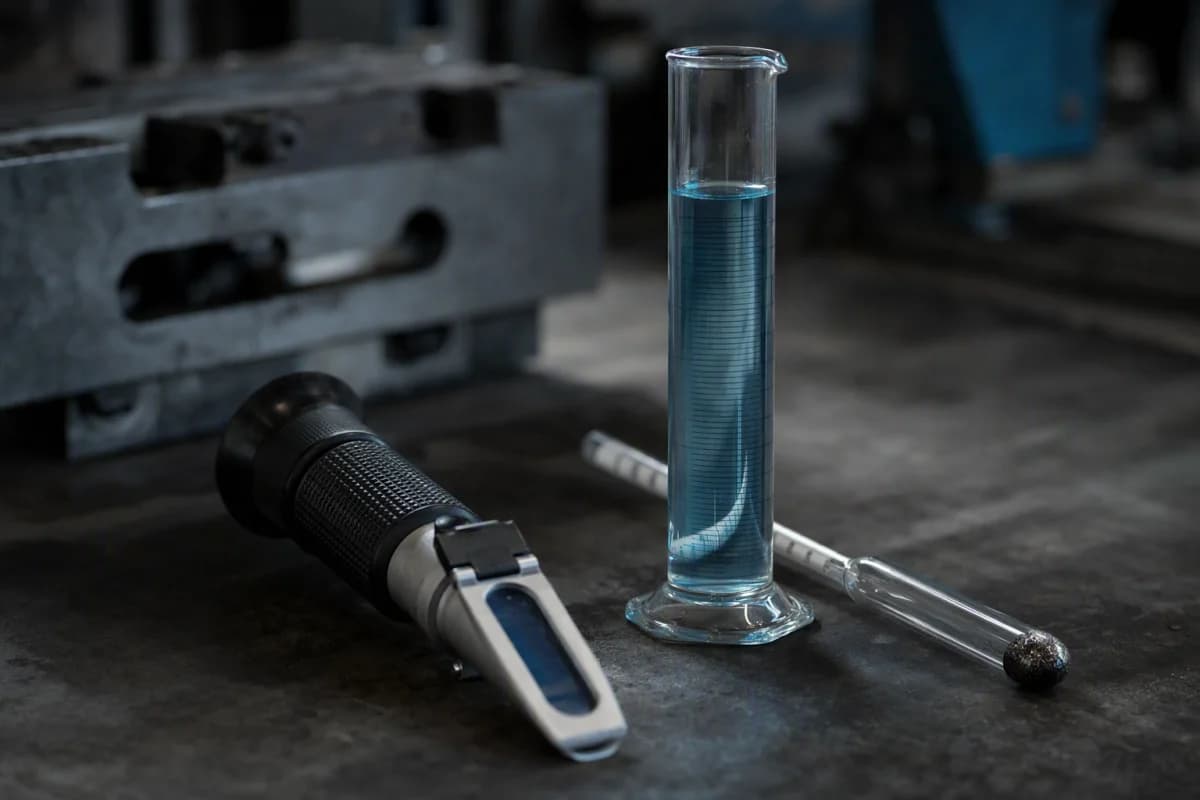
- Establish the current concentration. Use a refractometer or hydrometer calibrated for your glycol type. Do not rely on a drum label, a commissioning record from three years ago, or the look of the fluid.
- Establish the target from your lowest real temperature and the circulation requirement, using the property table for the exact product.
- Decide the direction and amount. If you are low, add concentrate; if you are high, add water. Change in steps rather than one large addition.
- Circulate before sampling. A freshly added charge is not mixed. Take the sample after the loop has run long enough to be representative.
- Re-measure and repeat if needed. Confirm you reached the target rather than assuming it.
- Record it. The value and date belong in the same log as pH and inhibitor readings.
The trap in step 3 is adding "until it looks right." A glycol solution's appearance does not indicate its strength, and colour varies between formulations — the same point covered in how to read a coolant datasheet.
Concentration is not the whole protection question
A correctly concentrated charge can still be a degraded charge. Glycol concentration and inhibitor condition are separate measurements, and a loop can pass the first while failing the second.
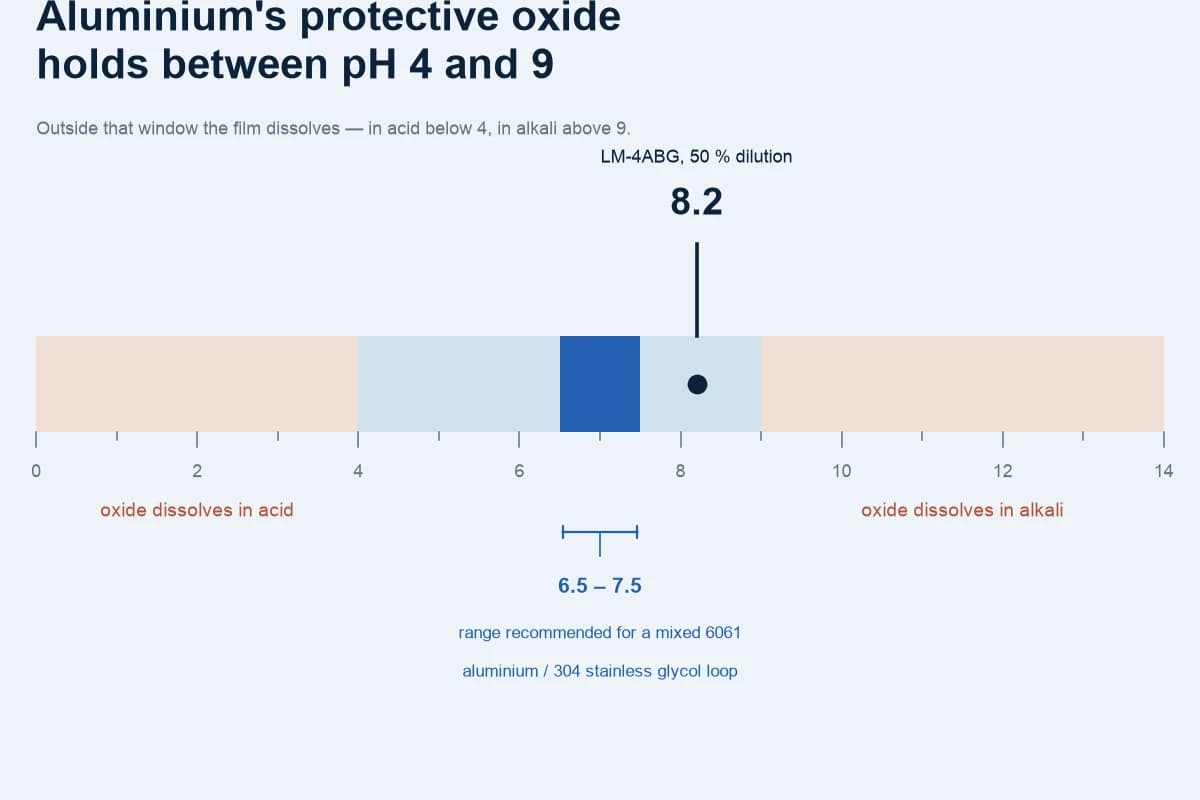
If the fluid has been in service for years, or the make-up history is unknown, check pH, reserve alkalinity and inhibitor level alongside the concentration. Rising conductivity or falling pH in an inhibited aqueous loop is a signal about fluid condition, not about strength — the parameters and their intervals are set out in when to change a coolant and coolant maintenance.
For a changeover rather than a top-up, the cleaning and compatibility questions come first; see what to confirm before you drain the loop.
Not every product is diluted
One important boundary: this whole procedure applies to the dilutable glycol-type and diol coolants, where the user sets the concentration. It does not apply to every family.
The salt-based grades such as LM-8A and the anhydrous families are supplied for use as received, and no dilution step applies to them. Diluting a product that is not designed to be diluted changes its inhibitor balance and can defeat its protection entirely. Confirm which category your fluid falls into before adjusting anything — the glycol-type versus organic-salt comparison sets out how the families differ.
For food-industry loops the requirement is narrower again: LM-4B is the food-processing secondary coolant, and its concentration table is the one to consult. The supporting documentation should be confirmed for the application.
Finding your target concentration
A target concentration for your system has to come from a site assessment, and nothing here replaces your product's technical data sheet. The table above is reference data for one family at stated concentrations. Your target depends on your glycol type, your lowest real temperature, your circulation requirement and the condition of the fluid already in the loop — four things only a site assessment can establish. Bring those four to your supplier and ask for the target in writing.
QUICK CLARIFICATIONS
Common questions.
Can I work out the concentration from the freezing point I want?
Only in one direction, and only with the right table. Use the property table for your exact product and glycol type to find the concentration that delivers the protection you need at your lowest temperature. Do not infer concentration backwards from a visual check — the appearance of a glycol solution does not indicate its strength, and colour varies between formulations.
Is it better to run slightly stronger than the target?
Not automatically, and not without limit. Concentration raises viscosity as well as lowering freezing point, so running stronger than needed increases pumping demand and can cost more energy than it buys in protection. The LM-4 table also shows the freezing point curve turning: 80 wt% delivers a figure below −45 °C while 90 wt% is −29.5 °C. Past the peak, more glycol buys less protection. Run the concentration the application requires, and confirm the target with the supplier for your specific product.
My loop is a salt-based or anhydrous fluid, not a glycol. Does this apply?
No. This covers dilutable glycol-type and diol coolants, where the user sets the concentration. The salt-based families such as LM-8A and the anhydrous families are supplied for use as received. Do not dilute a product that is not designed to be diluted — confirm which category your fluid belongs to first.
How often should I re-check the concentration?
Any time the loop has been topped up, drained, repaired or opened. Concentration drifts through make-up water, small leaks and inhibitor adjustments, so the sensible approach is to fold a concentration check into the same routine as the pH and inhibitor checks — see the maintenance intervals discussed in the coolant degradation guide. A figure recorded at commissioning describes only that moment.
CHECK THE SOURCE
References & scope.
- Glacier catalogue — LM-4 series concentration, freezing point and viscosity table (Table 3)
- Glacier catalogue — LM-4B concentration-dependent properties (Table 7)
- Glacier catalogue — LM-8 series physical parameters (Table 9)
Obtain the relevant TDS, SDS and technical approval before use.
How we prepare our content