Pumping energy, not heat capacity, decides a low-temperature coolant
Low-temperature secondary coolants differ only slightly in volumetric heat capacity, yet their pumping demand can differ by an order of magnitude.
THE SHORT ANSWER
What you need to know.
Volumetric heat capacity differs by only a few percent between common low-temperature secondary coolants, so it rarely separates them. Kinematic viscosity at the lowest loop temperature does, because it sets pumping power. Ask for viscosity data at your operating temperature rather than comparing room-temperature stock figures.
- Volumetric heat capacity spread across common secondary coolants is under 5 percent.
- Viscosity at the lowest loop temperature drives pumping power, and it can vary by more than an order of magnitude.
- A stock viscosity figure at 20°C does not describe behaviour at a −30°C operating condition.
The part of the energy bill nobody models
When a low-temperature secondary loop is designed, the fluid usually arrives at the end of the process. The temperature window is set, the materials are chosen, the pump has been sized from a preliminary flow rate, and the coolant is selected to fit. The pumping energy that the fluid choice implies is rarely revisited afterwards.
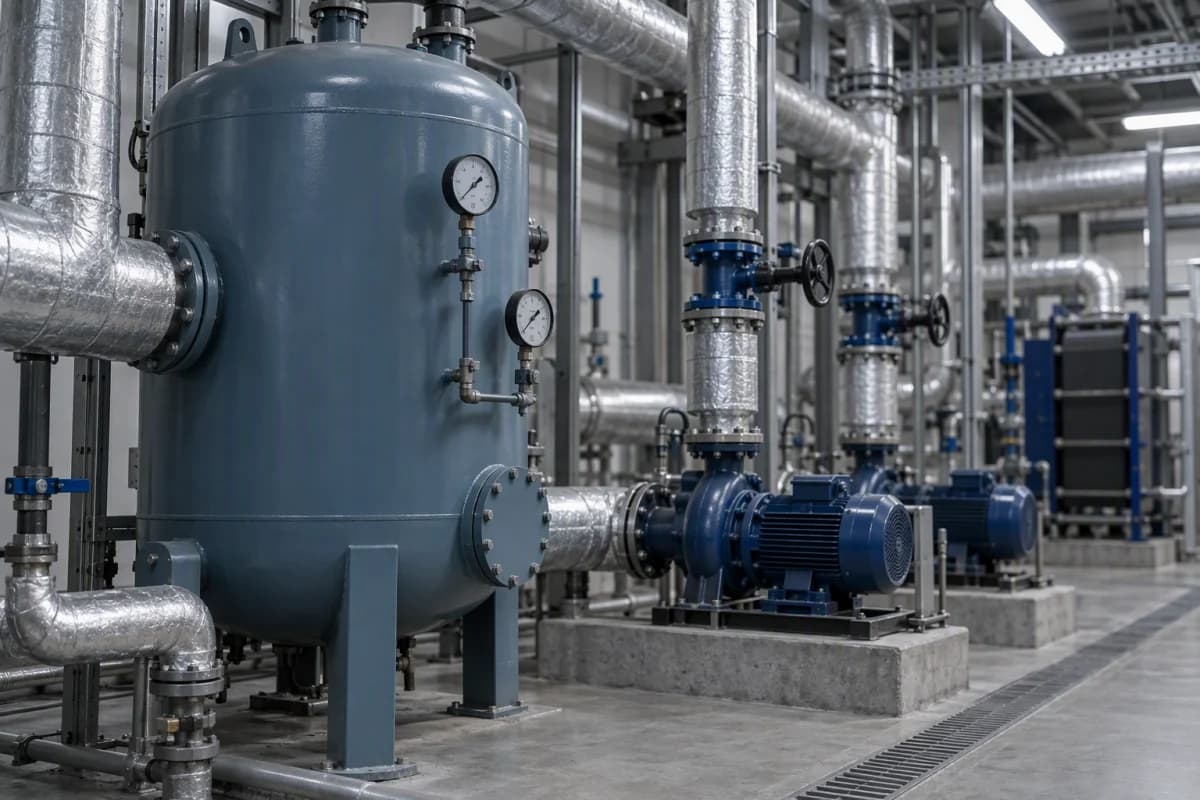
That is a costly omission, and the refrigerant transition is making it more common. F-gas rules have been pushing industrial and commercial refrigeration towards indirect architectures with a smaller primary charge and a larger circulating secondary loop. Every kilowatt of extra pumping power in that loop now runs for the life of the plant. The industrial cooling solution page sets out how the loop sits within the wider system; the number that decides the fluid is viscosity.
Three properties, and only one of them moves much
The energetic performance of a secondary coolant is governed by three properties:
- Volumetric heat capacity (Cp·ρ) — how much energy a given volume carries per degree. Higher values mean lower volume flow for the same refrigeration duty, which means smaller pumps and smaller pipes.
- Thermal conductivity (λ) — how readily heat crosses the fluid film at the heat exchanger.
- Kinematic viscosity (ν) — how much pressure the fluid loses as it moves, and therefore how much pump power the loop consumes.
Designers tend to reason about the first two, because they are the properties that describe how much cooling the fluid can carry. The published comparison data points somewhere else.
A technical paper comparing water-based secondary coolants at a −30 °C operating temperature, with a −40 °C freezing point, reports volumetric heat capacity as follows:
| Fluid | Volumetric heat capacity at −30 °C | Difference |
|---|---|---|
| Potassium formate | 3,593 kJ/m³·K | — |
| Propylene glycol | 3,590 kJ/m³·K | 0.1% lower |
| Potassium acetate | 3,515 kJ/m³·K | 2% lower |
| Calcium chloride | 3,448 kJ/m³·K | 4% lower |
A spread of four percent. The paper's own conclusion is blunt: the differences are small, and propylene glycol is absolutely competitive on this measure. Volumetric heat capacity does not separate these fluids.
What the −30 °C comparison shows
Viscosity behaves differently. For the same comparison set at −30 °C:
| Fluid | Kinematic viscosity at −30 °C |
|---|---|
| Potassium formate | 10.3 mm²/s |
| Calcium chloride | 11.9 mm²/s |
| Potassium acetate | 23.9 mm²/s (about 130% higher) |
| Propylene glycol | 272 mm²/s (roughly 25 times higher) |
Now the consequence, on a common basis of 10 kW refrigeration capacity and DN 35 × 1.5 pipe:
| Fluid | Pumping power per metre of pipe at −30 °C |
|---|---|
| Potassium formate, calcium chloride, potassium acetate | about 1 W/m |
| Propylene glycol | 11.3 W/m |
The same comparison at −50 °C separates the low-viscosity fluids from each other while leaving glycol in the same place: the paper reports 2.6 W/m for a potassium formate grade, 2.4 W/m for a potassium acetate grade, 2.3 W/m for 29.9% calcium chloride, and 10.2 W/m for 60% ethylene glycol.
The paper also compares thermal conductivity, where calcium chloride leads at 0.493 W/m·K, potassium formate F40 sits 12% lower at 0.436, potassium acetate 15% lower at 0.418, and propylene glycol 35% lower at 0.323.
Disclose the interest. That paper was published by TYFOROP, a manufacturer of potassium formate and potassium acetate coolants. It is a competitor's technical document, and the numbers should be read with that in mind. We cite it because the measurement conditions are stated, the comparison is on a common basis, and it is one of the few public sources that puts pumping power per metre of pipe next to viscosity for the same set of fluids at the same temperature. It is presented here as the paper's reported values, not as an independent test.

Stock viscosity is not operating viscosity
The reason this matters for selection is the shape of the viscosity curve, not one number.
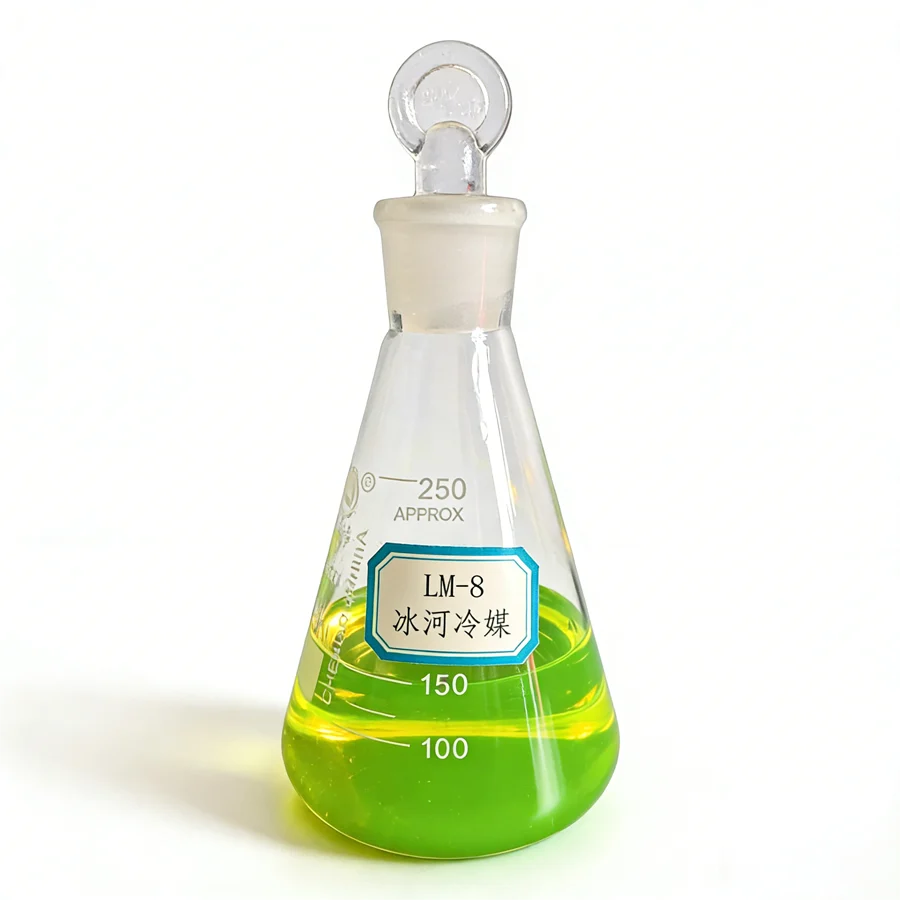
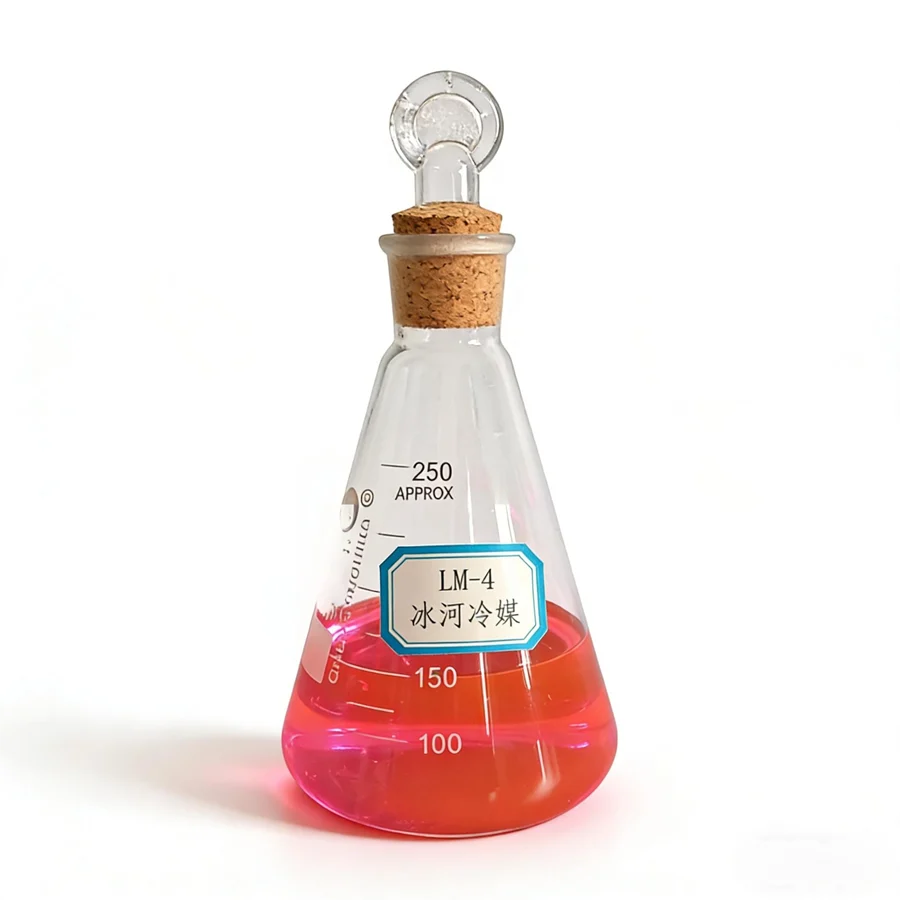
Viscosity rises steeply as temperature falls, so a single figure taken at 20 °C describes a condition a low-temperature loop spends no time at. Viscosity data is published — the LM-4 series physical-parameter table gives concentration-dependent viscosity alongside freezing point and density, and the LM-8 series table gives a stock viscosity of 3.78 cP at 20 °C. What those tables do not give you is a value at your operating condition. Each figure is measured at the temperature stated for that concentration, and the separate LM-4 series model table lists temperature ranges and compatible metals without repeating the viscosity figures.
Plotted out, the shape of the LM-4 data makes the point better than the individual figures:
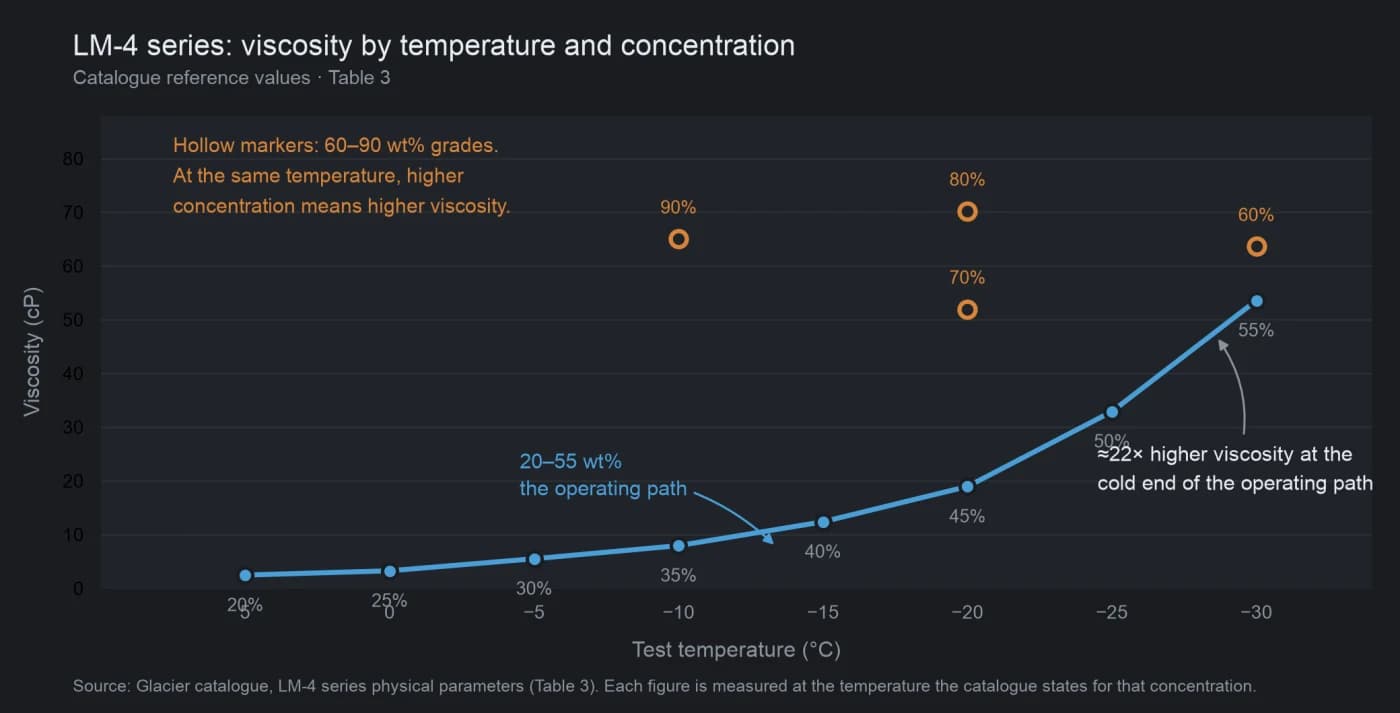
Two effects are visible at once. Following the operating path — 20 wt% at +5 °C through to 55 wt% at −30 °C — viscosity rises roughly twenty-two-fold. And the higher-concentration grades sit above that path: at the same test temperature, more glycol means more viscosity. Both effects push in the same direction for pumping power.
The practical implication is narrow and useful: a room-temperature viscosity comparison between two candidate fluids is close to meaningless, and a comparison between two suppliers' rooms-temperature figures is worse, because the measurement conditions may differ. What you need is the viscosity curve across the operating range, at the concentration you will actually run.
Concentration compounds this. Glycol loops are commonly specified at the concentration that protects against the coldest expected condition, and a higher glycol fraction means higher viscosity and higher pumping power. The question worth asking is not only what protects the loop, but what the loop pays for that protection every hour of the year.
The data to request before you shortlist
- Viscosity at the lowest loop temperature, at the intended concentration, with the test method stated.
- Density and specific heat over the same range, so volumetric heat capacity can be calculated rather than assumed.
- Thermal conductivity over the same range.
- Material compatibility for the actual wetted materials. Chemistry-specific limits apply here and they are not interchangeable. Organic-salt coolants exclude soft solder and zinc, and require silver brazing at joints; it also warns that an inhibitor package proven in one fluid chemistry may show negative synergies in another.
- A pumping estimate on your pipework, or enough data to calculate one. A per-metre figure from a generic comparison is a sanity check, not a design.
- The changeover plan if you are switching chemistry, including whether existing joints and galvanised components are acceptable.
What a loop survey has to establish
It does not recommend a fluid for your loop, and it does not claim that any Glacier product is equivalent to the fluids named in the comparison above. The LM-4 family is a modified-diol range and LM-8 a modified organic-acid-salt range; those are formulation descriptions, not an identification with any specific chemistry.
It also does not claim that a low-viscosity fluid is always the better choice. Pumping power is one line in a total-cost calculation that also includes purchase cost, fluid life, heat-exchanger sizing, corrosion protection, material changes required, and safety. A fluid that saves pump energy but forces a plant to replace every soldered joint is not a saving. If you are weighing a chemistry change, the system protection solution page and the technical document request page are the places to start — and any decision should rest on data at your operating conditions, confirmed with the supplier in writing.
QUICK CLARIFICATIONS
Common questions.
Is volumetric heat capacity irrelevant to coolant selection?
No, but it rarely decides between candidates. Published comparisons of common water-based secondary coolants put the spread in volumetric heat capacity at under five percent, while viscosity at the operating temperature varies far more widely.
Why can't I compare the viscosity figures on two datasheets?
Unless both figures are stated at the same temperature and concentration, they describe different conditions. Viscosity rises steeply as temperature falls, so a 20°C stock value says little about a −30°C loop.
Does a low-viscosity fluid suit every system?
No. Chemistry-specific material compatibility still applies. Organic-salt coolants, for example, exclude soft solder and zinc, and warns that an inhibitor package proven in one fluid chemistry may not transfer to another.
CHECK THE SOURCE
References & scope.
- Glacier catalogue — LM-4 series viscosity by concentration and temperature (Table 3)
- TYFOROP — Thermophysical properties and corrosion behaviour of secondary coolants (technical paper)
- Glacier catalogue — LM-8 series physical parameters (Table 9)
- Glacier catalogue — LM-4 series models and properties (Table 4)
- European Commission — Climate-friendly alternatives to F-gases in refrigeration
Obtain the relevant TDS, SDS and technical approval before use.
How we prepare our content