
Choose for the circuit
Discuss pharmaceutical, chemical and HVAC circulation separately from fuel-cell or data-centre cooling. An industrial formulation is not automatically suitable for an electronic cooling loop.
Heat transfer fluids
The versatile industrial range: water-dilutable fluids with model-specific options for aluminium protection, elevated temperatures, pharmaceutical processes and data-centre circulation.
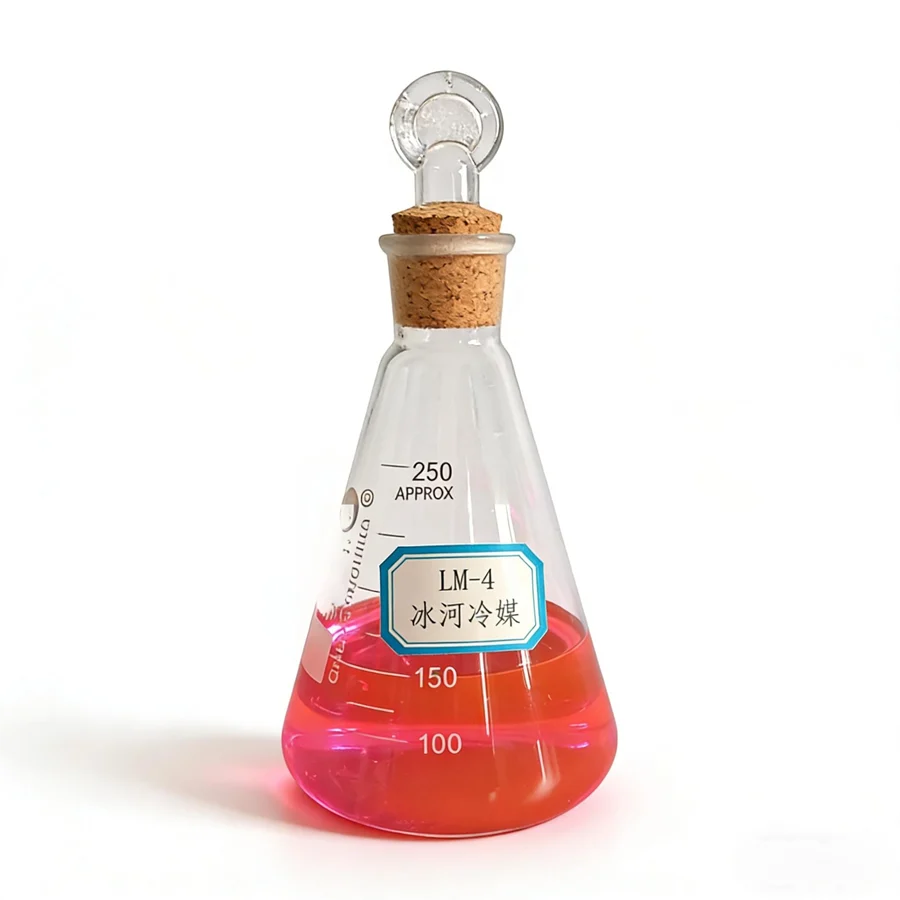
Modified diols
| Property | LM-4 | LM-4D | LM-4D-YE |
|---|---|---|---|
| Base fluid | Modified glycol | Modified glycol/water | Modified glycol in deionised water |
| Inhibitor system | Corrosion inhibitors, anti-mildew agents, solubilisers, water stabilisers | Non-ionic organic; free of silicon, phosphorus, amines and nitrites | Organic composite; free of silicon, phosphorus and nitrites |
| Operating range (°C) | −35 to +150 for the series | −35 to +100 | −35 to +130 |
| Electrical conductivity, undiluted (µS/cm) | 1580 | <1 | — |
| Electrical conductivity, 50 % dilution (µS/cm) | 2520 | 1.01 | 502.9 |
| Boiling point (°C) | >140 | — | — |
| Flash point (°C) | >120 | — | — |
| Viscosity at 20°C, undiluted (cP) | 13.92 | — | — |
| Density at 20°C, undiluted (g/cm³) | 1.105–1.125 | — | — |
| Specific heat at 20°C (cal/g·°C) | 0.619 | — | — |
| Thermal conductivity at 20°C (W/(m·K)) | 0.26 | — | — |
| Metals | Carbon steel, stainless steel, copper | Aluminium, stainless steel, brass, copper | Aluminium, stainless steel, carbon steel, copper |
| Dilution water | Water | Ultrapure water | Purified water |
From the manufacturer's data-centre application document. LM-4D is described there with a 50 % dilution conductivity below 5 µS/cm and tabulated at 1.01 µS/cm; the tabulated figure is the measurement and the stated limit is the ceiling. Its LM-4D-YE operating range is −35 to +130°C; the manufacturer's BESS liquid-cooling document states −35 to +150°C for the same model.
| Property at 50 % dilution | LM-4 | LM-4D | LM-4D-YE |
|---|---|---|---|
| Freezing point (°C) | −35 | −35 | −34 |
| Boiling point (°C) | 107 | 107 | 107 |
| pH | 6.27 | 6.27 | 8.93 |
| Electrical conductivity (µS/cm) | 2520 | 1.01 | 502.9 |
| Viscosity at +20°C (cP) | 3.75 | 3.88 | 4.30 |
| Viscosity at +10°C (cP) | 5.17 | 5.47 | 6.09 |
| Viscosity at 0°C (cP) | 8.02 | 8.25 | 9.18 |
| Viscosity at −10°C (cP) | 12.9 | 13.19 | 15.14 |
| Viscosity at −20°C (cP) | 22.30 | 23.40 | — |
| Density at +20°C (g/cm³) | 1.066 | 1.068 | 1.070 |
| Density at +10°C (g/cm³) | 1.071 | 1.074 | 1.075 |
| Density at 0°C (g/cm³) | 1.076 | 1.080 | 1.080 |
| Density at −10°C (g/cm³) | 1.080 | 1.084 | 1.085 |
| Density at −20°C (g/cm³) | 1.084 | 1.089 | — |
Reference values from the Chaoyang Guangda LM catalogue — typical figures rather than guaranteed limits. Confirm the exact model and concentration on the current model TDS before specifying.
View source: catalogue p.11 (PDF p.15)Model and dilution set the operating limits. LM-4D takes ultrapure-water dilution with conductivity and pH checks every three months. Compatibility is listed per model in the tables below; zinc and galvanised metal fall outside the compatibility list for LM-4D. Immersion service takes a fluid specified for immersion.
FROM FORMULATION TO APPLICATION
The LM-4 range spans industrial secondary cooling and specialised electronic cooling circuits. Model suffixes matter: they identify different material-compatibility and application requirements.
Discuss pharmaceutical, chemical and HVAC circulation separately from fuel-cell or data-centre cooling. An industrial formulation is not automatically suitable for an electronic cooling loop.
Confirm the water quality, dilution and inhibitor programme for the selected model. Do not extend an aluminium-compatibility statement or low-conductivity value to the whole family.
LM-4 · LM-4L · LM-4G · LM-4GL · LM-4BP · LM-4D · LM-4D-YE
Application notes are adapted from Glacier’s original product information. Unless a table states otherwise, numeric specifications follow the supplied catalogue. For the confirmed specification, obtain the current model-specific TDS and SDS. Links below point to the original source pages, not new technical documents.
A coolant quote is only comparable when the model, concentration, quantity, packaging, delivery basis and technical documents match. Use this checklist before choosing on price.
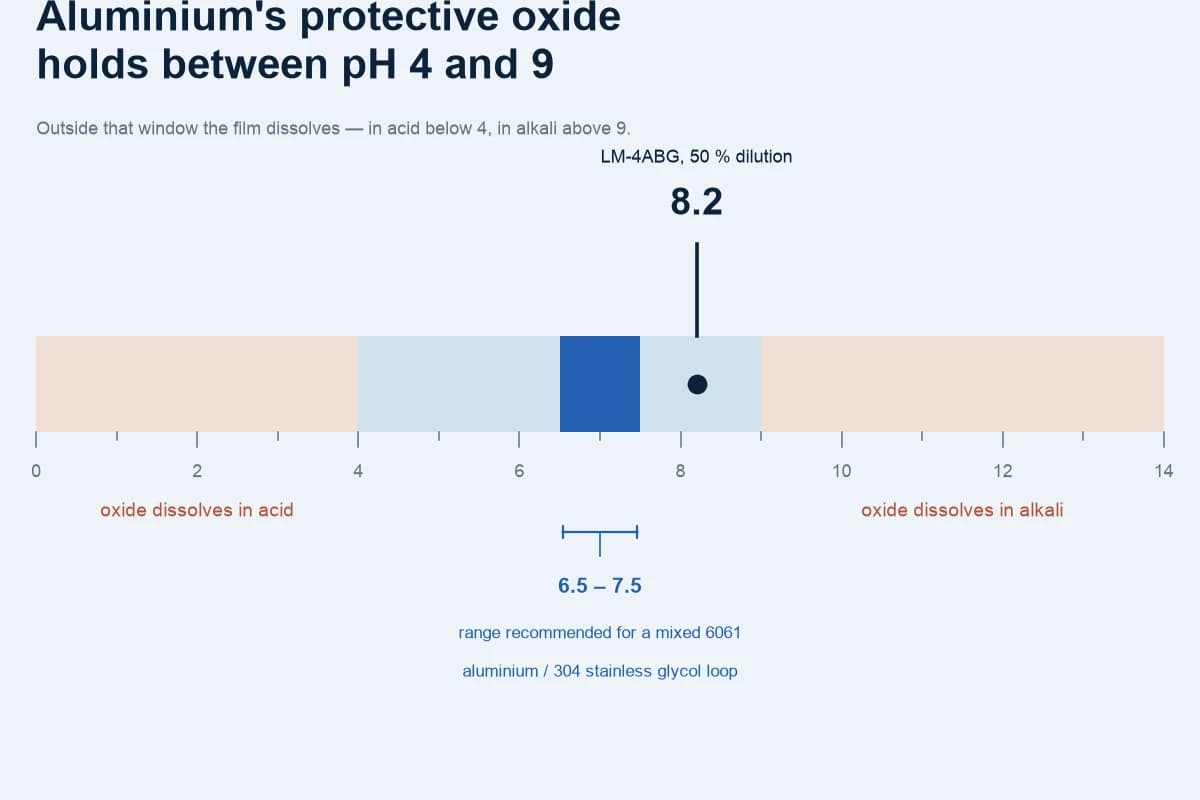
Aluminium's protective oxide is stable only between pH 4 and 9. What that means for choosing a secondary coolant, and why some model codes carry a trailing L.
CONTINUE EXPLORING
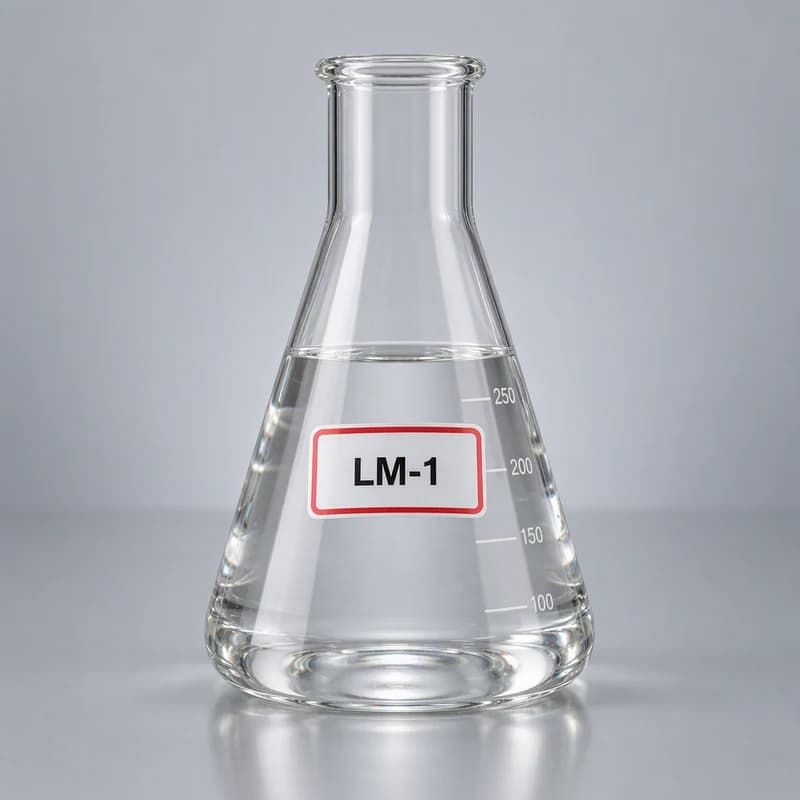
Low-temperature, alcohol-based coolant
Low-temperature coolant for mixed-metal systems
Application-specific alcohol coolants