Aluminium in a cooling loop: which secondary coolants protect it
Aluminium's protective oxide is stable only between pH 4 and 9. What that means for choosing a secondary coolant, and why some model codes carry a trailing L.
THE SHORT ANSWER
What you need to know.
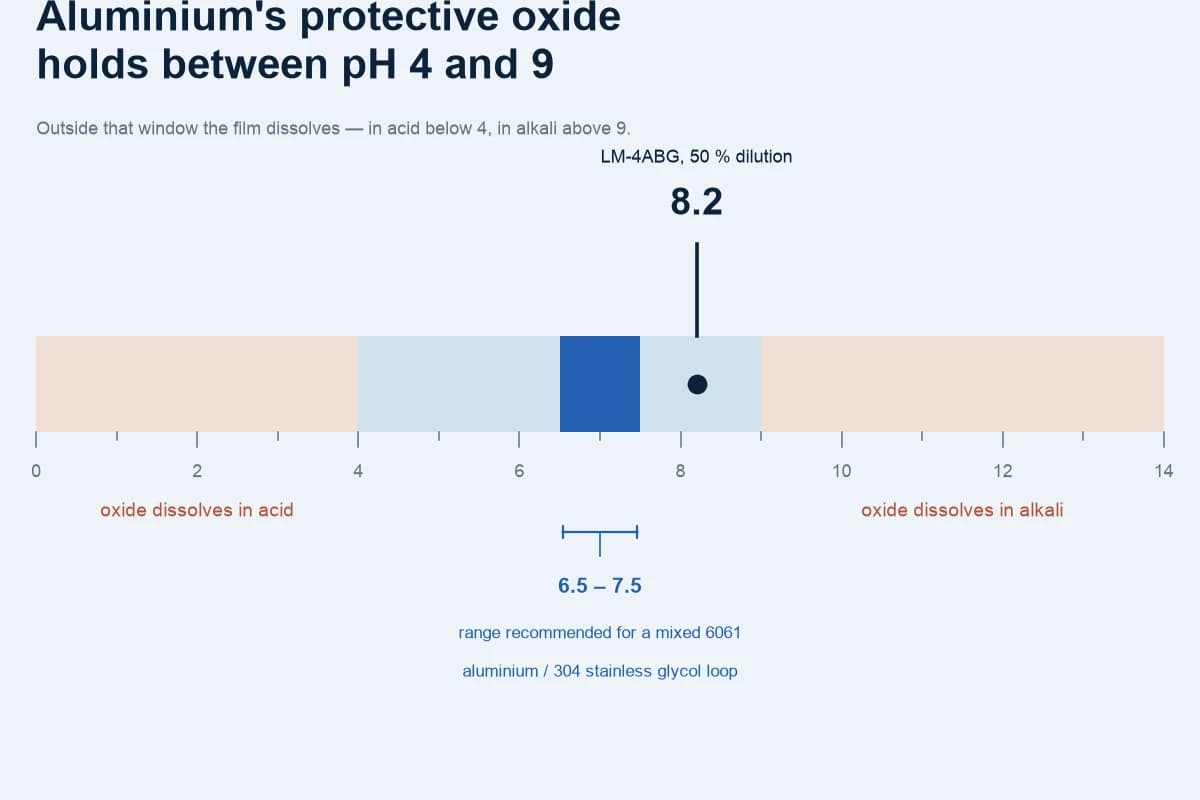
Aluminium protects itself with a thin oxide film that is stable only between roughly pH 4 and pH 9. Outside that window the film dissolves — in acid below 4, in alkali above 9 — and the metal corrodes without the fluid changing colour. Most inhibited glycols run alkaline to protect ferrous metals, so an aluminium loop sits near the upper edge of the window rather than the middle of it. Coolant families that offer an aluminium-compatible variant mark it with a trailing L in the model code.
- Aluminium's oxide is amphoteric: it dissolves in both acid and alkali, so a fluid is not automatically safe for aluminium just because it is not acidic.
- A coolant formulated for aluminium carries a specific inhibitor package; the trailing L in a model code is the marker for it across several families.
- Aluminium is a family of alloys, not one metal. Pure aluminium and the 1xxx series behave differently from the 3xxx and 6xxx alloys used in brazed plate heat exchangers and cold plates.
Aluminium is the metal that behaves differently
Most metals in a secondary loop rely on an oxide or a passive layer for their corrosion resistance. Copper builds a patina, stainless steel builds a chromium-rich passive film, carbon steel depends almost entirely on the inhibitor package in the fluid.
Aluminium does all of that with a film that has an unusual weakness: aluminium oxide is amphoteric. It dissolves in acid and it dissolves in alkali. The film is chemically stable across a pH window of roughly 4 to 9, and outside that window it is stripped away faster than it can re-form.
That single fact explains most aluminium failures in liquid cooling, and it also explains why a fluid can be perfectly safe for the rest of the circuit and still be the wrong choice for the one aluminium component in it.
Why inhibited glycols run alkaline — and where that leaves aluminium
Glycol does not corrode metal by itself. It degrades into acidic by-products, and those acids are what attack the loop. The standard answer is to buffer the fluid alkaline and add corrosion inhibitors, which is why an inhibited glycol typically sits somewhere above neutral.
That is the right call for carbon steel, which is the most corrosion-prone common metal in a secondary loop. It also moves the fluid toward the upper end of aluminium's window.
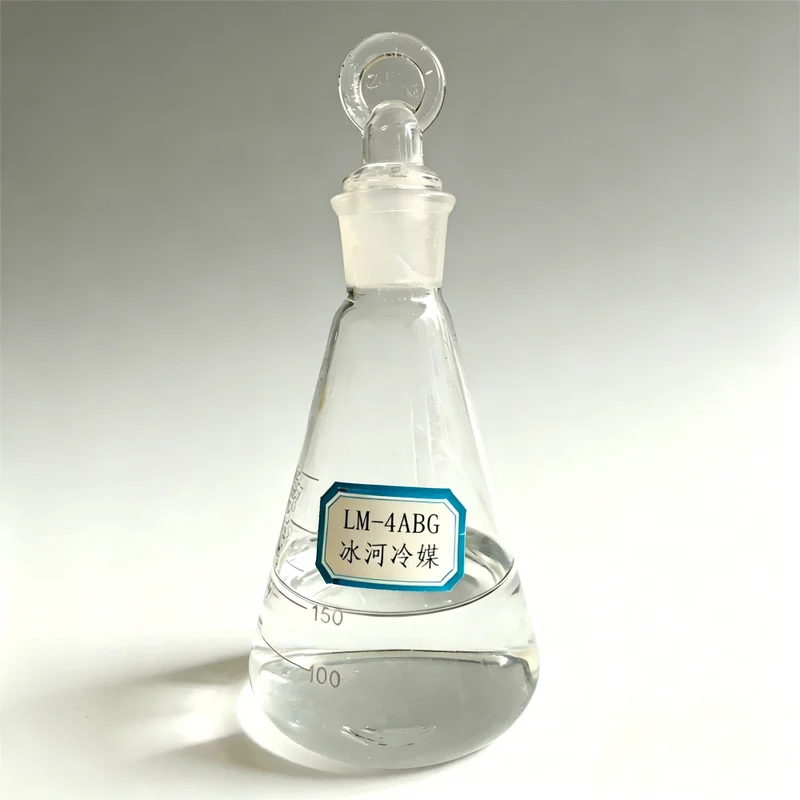
The numbers show the tension rather than resolving it. The LM-4ABG technical data sheet states a pH of 8.2 at 50 % dilution — propylene glycol, inhibited, food-grade process duty. That is inside aluminium's 4 to 9 window, with about eight tenths of a pH unit of headroom above it.
A study of a mixed 6061 aluminium / 304 stainless steel propylene glycol loop puts the practical control range at pH 6.5 to 7.5, with 6.8 as the weakest corrosion case, and records more aluminium corrosion at pH 8.8 than at 6.8. The same study found 304 stainless steel better behaved than the aluminium across every pH tested — which is the point. In a mixed-metal loop the two materials do not want the same pH, and the aluminium is the one that loses.
The trailing L is the marker for an aluminium circuit
Rather than asking a buyer to read an inhibitor formulation, the model codes carry the answer. Across the water-dilutable families, the aluminium-compatible variant adds a trailing L:
| Base model | Aluminium-compatible variant |
|---|---|
| LM-1 | LM-1L |
| LM-3 / LM-3A | LM-3AL |
| LM-4 | LM-4L |
| LM-4G | LM-4GL |
| LM-4AB | LM-4ABL |
| LM-4ABG | LM-4ABGL |
| LM-8 / LM-8G | LM-8L / LM-8GL |
| LM-850 | LM-850L |
Not every family offers the variant, so the model list for the specific family is what settles it.
The suffix marks the formulation, not a certificate: it tells you the inhibitor package is intended for a circuit containing aluminium, and the alloy list on the model's own sheet is still the thing that decides. And the metal list is alloy-specific. The LM-4D formulation, for example, lists 3-series and 6-series aluminium alloys as compatible while excluding pure aluminium and the 1xxx series — the same element, different behaviour.
What else in the fluid decides the outcome
Chloride. It attacks the oxide directly and produces pitting rather than even loss, so a cold plate or a brazed heat exchanger can perforate while a wall-thickness reading still looks acceptable. Below about pH 9 the aluminium surface carries a net positive charge that draws the chloride ion in, which makes chloride-bearing brines and aluminium a structurally difficult pairing.
Copper in the same circuit. An aluminium cold plate paired with copper heat exchangers adds a galvanic couple. The two metals sit far apart on the galvanic series in the same electrolyte, and the aluminium — the more anodic side — corrodes faster than it would on its own. The inhibitor package in an L formulation addresses chemical corrosion, but a galvanic pair is an electrical problem: the driving force is the potential difference between the two metals, not the pH of the fluid. Keeping the circuit clean, the water quality consistent and the flow rate even across the aluminium surfaces limits the effect, but the pairing itself is a design constraint rather than a fluid choice.
Conductivity and water quality. Low-conductivity formulations are specified around ultrapure or deionised water for the dilution. Diluting with tap water adds the ions that raise conductivity, and it can add chloride with them.
Temperature. The oxide re-forms faster when oxygen and water are available, and the corrosion rate climbs with temperature. A loop that sits at 60 °C has less margin than the same loop at 20 °C.
Stagnation. Aluminium under a deposit or a stagnant pocket loses the oxygen it needs to repair its film, and the pit that starts there is the one that perforates.
What to confirm before specifying
Four things, in this order:
- The alloy, not the word. Wrought alloy and series number for every aluminium part — cold plate, brazed heat exchanger, dry cooler fins, pipework. "Aluminium" alone is not a specification.
- The variant. Whether the model code carries the L, and whether that model's own metal list includes the alloy you have.
- The pH band you will hold in service, not the number on the drum. An inhibited glycol's pH is buffered, but the buffer is consumed. If pH is the control variable for aluminium, it is a monitored variable.
- The chloride path. Whether chloride can enter through the dilution water, the make-up water or the process side, and what limits it.
An aluminium loop is a mixed-metal loop. The question is not whether a coolant suits aluminium in general — it is which formulation, at which pH, against which alloy list, with which monitoring interval.
The pH tension in this pairing comes from the same fact: a fluid designed for a carbon steel or stainless steel loop runs more alkaline than a mixed-metal study recommends for 6061 aluminium and 304 stainless steel together. That does not make one number right and the other wrong — it makes the metal mix part of the specification. A loop with no aluminium runs well at pH 8.2. One with aluminium cold plates, copper heat exchangers, or both, has a narrower band and a different monitoring schedule.
QUICK CLARIFICATIONS
Common questions.
My glycol is alkaline, so is it safe for aluminium?
Alkaline is not automatically safe. Aluminium's protective oxide is stable up to about pH 9 and dissolves above it, so an alkaline fluid is protective only while it stays inside that window. A pH at the top of the range leaves less margin than one near neutral, and the mixture matters as much as the number: a 6061 aluminium and 304 stainless pair in propylene glycol has been studied at pH 6.5 to 7.5, with 6.8 the weakest corrosion case.
How do I tell whether a coolant variant is made for aluminium?
The model code carries it. Across the water-dilutable families, the aluminium-compatible variant adds a trailing L — LM-1L, LM-3AL, LM-4L, LM-4GL, LM-4ABL, LM-4ABGL, LM-8L, LM-8GL. The base model and the L variant are otherwise the same family, so the letter is the only thing separating a circuit that includes aluminium from one that does not.
Does a higher pH protect better against corrosion?
Not for aluminium. Raising pH protects ferrous metals and, up to a point, reduces aluminium corrosion too — the 6061 alloy in propylene glycol corrodes least near pH 6.8 and more again at 8.8. Past the top of the window the same alkalinity that suppresses steel corrosion strips the aluminium oxide instead, so the two metals pull the target pH in opposite directions.
What about chloride?
Chloride attacks aluminium's oxide directly and causes pitting rather than uniform loss, and a pit can perforate a cold plate or a brazed heat exchanger long before the metal looks thin overall. Below about pH 9 the aluminium surface carries a net positive charge that attracts the chloride ion, which is one reason chloride-bearing brines and aluminium circuits are a difficult pairing.
CHECK THE SOURCE
References & scope.
- Glacier catalogue — LM-4 series models, aluminium-compatible variants and metal lists (Table 4)
- Technical data sheet — LM-4ABG inhibited propylene glycol
- Materials — Effect of propylene glycol coolant pH on the galvanic corrosion behaviour of 6061 aluminium alloy and 304 stainless steel
- Materials and Corrosion — Metallurgical aspects of the corrosion resistance of aluminium
Obtain the relevant TDS, SDS and technical approval before use.
How we prepare our content