My glycol concentration dropped — am I at risk of freezing or bursting?
Freeze protection and burst protection require different glycol concentrations. Learn the difference, and what to check before a cold weekend arrives.
THE SHORT ANSWER
What you need to know.
Freeze point and burst point describe two different thresholds, and the glycol concentration needed for freeze protection is higher than the concentration needed for burst protection. If your concentration has dropped, find out which type of protection your system was designed for before deciding whether to top up.
- Freeze point is where ice crystals first form and the fluid becomes slushy; burst point is where expansion threatens the pipework.
- Burst protection requires a lower glycol concentration than freeze protection, because slush can still accommodate expansion.
- A concentration figure taken at commissioning describes protection at that moment; dilution, top-ups and inhibitor depletion change it over time.
The call that follows a cold weekend
Every winter, a facilities manager somewhere walks into a plant on a Monday morning and finds that a chilled-water loop has been sitting idle through a freeze and something has gone wrong. The glycol concentration was checked at commissioning and never looked at again. The loop was topped up with plain water to make up a small leak. And nobody asked whether the system was designed for freeze protection, or only for burst protection.
Those two words are used interchangeably in purchase specifications, and they describe different things. The difference is the reason a concentration that protects a dormant pipe from splitting may still leave a pump unable to start. The two thresholds behave differently, and telling them apart decides whether you have a problem or a risk.
Freeze point is not burst point
The distinction is often collapsed into a single column on a datasheet.
The freeze point is the temperature at which ice crystals first begin to form in the fluid. At the freeze point the fluid becomes slushy. It does not yet expand with enough force to threaten the pipework, but it is also not pumpable. If the system needs to start and circulate in cold weather, the freeze point is the relevant limit.
The burst point is the temperature at which the cooling fluid expands with enough force to split pipework, crack a heat exchanger or rupture a seal. The burst point is lower — sometimes considerably lower — than the freeze point, because the slush that forms between the two thresholds can accommodate some expansion.
The practical consequence is that the glycol concentration needed for freeze protection is higher than the concentration needed for burst protection. A published comparison for a 10 °F (−12 °C) ambient condition puts the numbers in useful perspective: ethylene glycol requires a concentration of about 26% by volume to provide freeze protection at that temperature, and about 18% to provide burst protection. For propylene glycol, the comparable figures are about 30% for freeze protection and about 21% for burst protection.
Those are illustrative figures from a third-party source. The curve for your specific fluid, at the glycol type and inhibitor package you are actually using, may differ. What does not differ is the principle: the concentration that prevents bursting is lower than the concentration that prevents slush, and a system designed only to the lower number will not circulate in the cold.
What determines whether you need freeze or burst protection
The deciding factor is whether the system ever has to start from cold.
A chilled-water loop that circulates year-round needs freeze protection, because the pumps have to move fluid at the lowest temperature the loop sees, including during a cold start after a power outage. The concentration must hold the freeze point below the lowest ambient temperature the equipment is exposed to, with a margin for the coldest recorded outlier rather than the seasonal average.
A system that sits dormant through the winter and is only drained or re-started in spring may be adequately protected by burst protection. The pipes will not split, even if the fluid turns to slush. But "adequately protected" means protected against splitting — not against being unable to restart.
Systems that alternate between circulation and idle periods over a single cold season are the ones that most often fall between the two. A pipe that spent the week circulating above its freeze point and the weekend sitting still in a cold plant room may have been designed for freeze protection and now, through dilution or top-ups, is only burst-protected. Nobody will know until the pump is asked to start on a Monday morning.

Where the figures fit — and where they don't
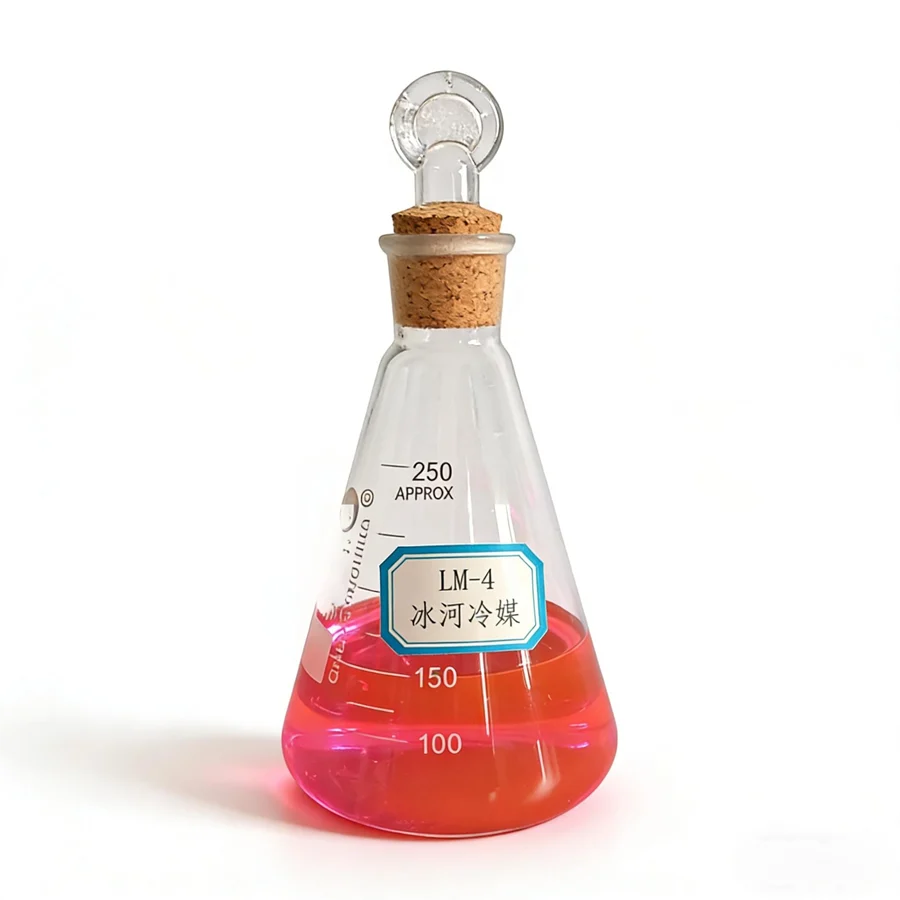
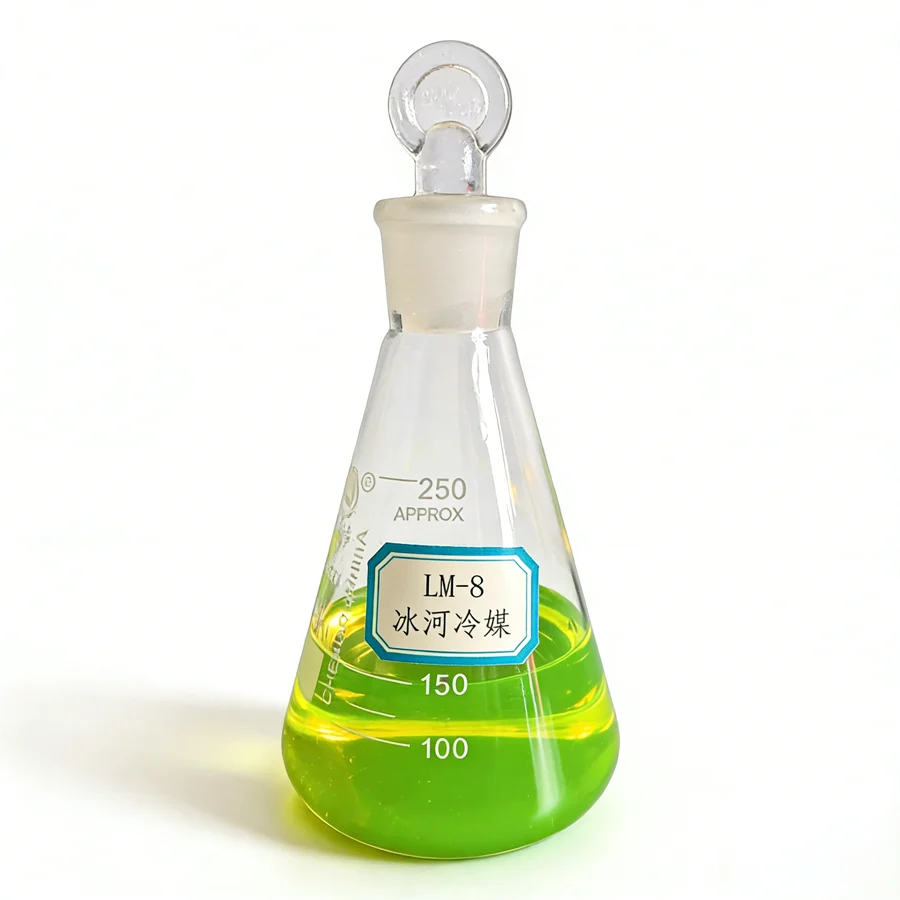
Freezing points are published for several families, and those figures are useful starting points for a system check. For LM-4B, the food-processing secondary coolant, the published freezing point is −17.5 °C at 40 wt% concentration and −25 °C at 50 wt%. For the LM-8 series, it lists stock freezing points below −60 °C for the base and L/GL variants, and −50 °C for the LM-850 series.
Those figures describe specific conditions. A published freezing point describes the stock fluid or one stated dilution, measured under a specific test method — the same "reference value" convention explained in how to read a coolant datasheet. It is not a burst point, and it is not a prediction of what will happen in your loop after three years of make-up water, inhibitor depletion and unspecified top-ups.
The difference between a freeze point and a burst point is also why no single concentration works for every system. Two identical loops in the same city, one circulating year-round and one drained for the winter, need different concentrations, and both need different concentrations from a loop in a colder climate with a different glycol type. The freeze point describes the fluid; your operating conditions and start-up requirements set the target.
What the curve looks like across a full range
Plotting freezing point against concentration shows something a single figure cannot: where each fluid stops being able to help.
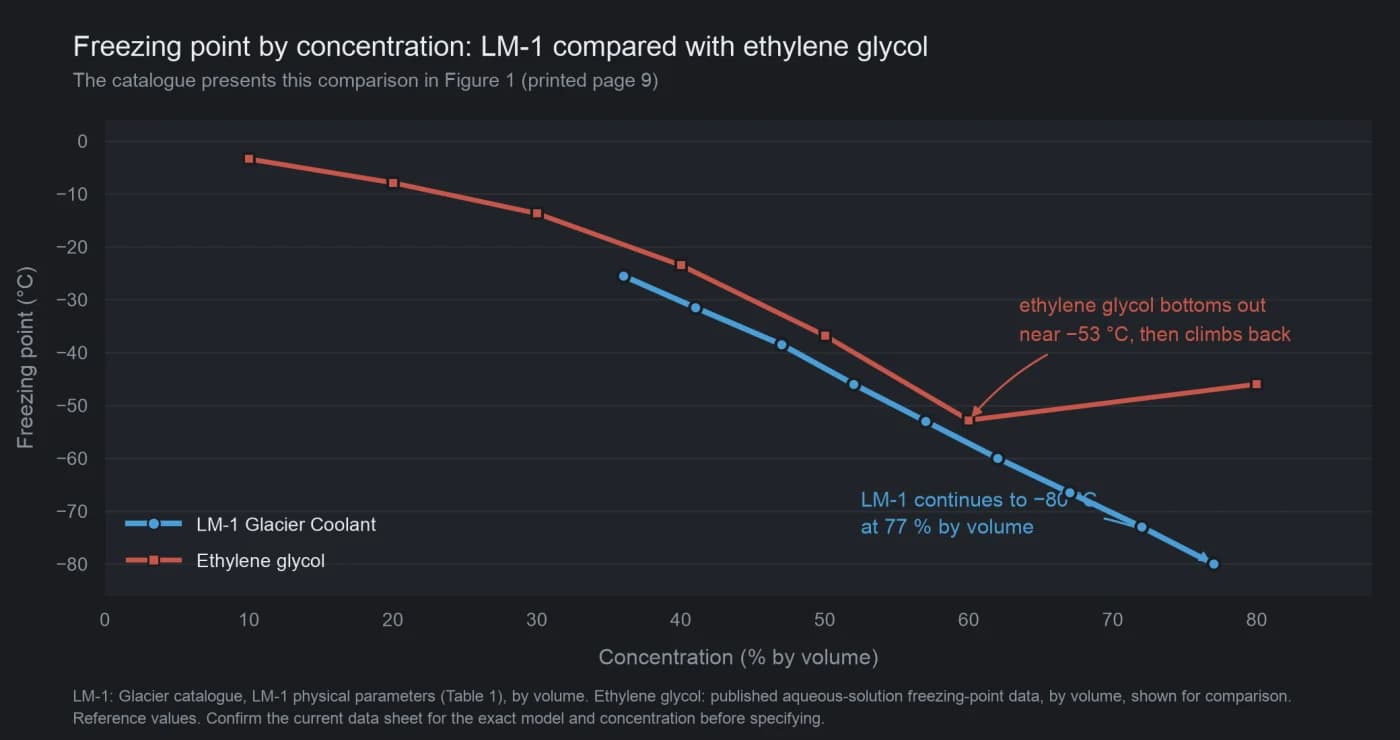
The figures behind the curve, so the numbers can be read directly rather than estimated off the image:
| Concentration (wt% / vol%) | Freezing point (°C) | Boiling point (°C) | Density at 20 °C (g/cm³) | Viscosity (cP) |
|---|---|---|---|---|
| 30 / 36 | −25.5 | 82 | 0.954 | 7.19 at −15 °C |
| 35 / 41 | −31.5 | 81 | 0.946 | 9.48 at −20 °C |
| 40 / 47 | −38.5 | 79 | 0.937 | 15.38 at −30 °C |
| 45 / 52 | −46.0 | 77 | 0.929 | 19.36 at −35 °C |
| 50 / 57 | −53.0 | 76 | 0.920 | 23.43 at −40 °C |
| 55 / 62 | −60.0 | 75 | 0.906 | 37.46 at −50 °C |
| 60 / 67 | −66.5 | 74 | 0.892 | 39.72 at −55 °C |
| 65 / 72 | −73.0 | 73 | 0.881 | 44.01 at −60 °C |
| 70 / 77 | −80.0 | 72 | 0.870 | 65.99 at −70 °C |
Viscosity carries a temperature because it moves further than the other properties across this range: the pumping penalty between 36 vol% and 77 vol% is most of an order of magnitude, while the density changes by less than 10%.
Ethylene glycol's protection reaches its limit at around 60% by volume, near −53 °C, and then the curve turns back upward — pure glycol freezes at a higher temperature than the eutectic mixture. That is why adding more glycol beyond the eutectic does not buy deeper protection, and why a glycol loop cannot be pushed arbitrarily cold by increasing concentration.
The LM-1 curve continues past that point, reaching −80 °C at 77% by volume and lower at higher concentrations. For a loop running at −60 °C or below, that difference is the whole selection decision rather than a marginal preference.
The basis matters here: the LM-1 figures give both weight and volume percentages, and the comparison above is drawn on the volume basis. Mixing the two bases in one comparison is a common source of confusion — see how much glycol to add for why.
A winter-readiness checklist
The questions worth answering before the forecast turns cold:
- What was the design concentration, and what is it today? Measure with a refractometer or hydrometer calibrated for your glycol type. Do not rely on a label written on a drum three years ago.
- What is the lowest temperature the system will actually see? Use the site's coldest recorded ambient, not the seasonal average, and include any unheated plant rooms, rooftop pipe runs or shutdown periods.
- Does the system have to start and circulate at that temperature, or only survive it? The answer decides whether you are specifying to the freeze point or the burst point.
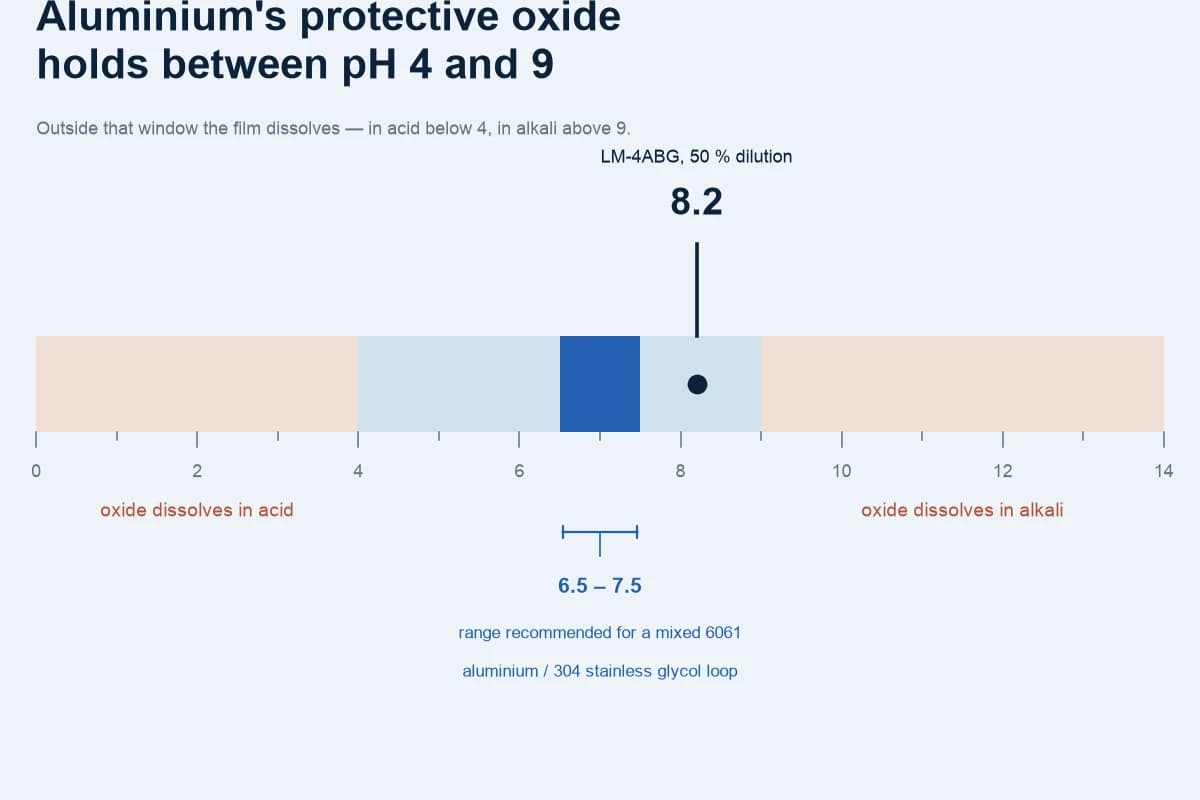
- What were the last pH, inhibitor and conductivity readings? A concentration that is numerically correct will not protect a system whose inhibitor has depleted or whose pH has dropped into the acidic range. A separate check on fluid condition belongs alongside the concentration check — see when to change a coolant.
- What has been used to top up? Plain water dilutes both glycol and inhibitor. If the make-up history is unknown, assume the concentration has drifted downwards and measure it.
- Are you comparing the right glycol type? Ethylene glycol and propylene glycol have different freeze-point and burst-point curves; a concentration figure written for one does not transfer to the other without re-checking the curve.
What a site survey has to establish
It does not tell you the safe concentration for your system. The figures quoted from the third-party source are illustrative, not a specification, and were measured on specific formulations under laboratory conditions. Those figures are reference values on either the stock fluid or one stated dilution. The concentration your system needs depends on your glycol type, your lowest real-world temperature, your start-up requirement and the condition of your fluid — four things that only a site survey can establish.
It also does not replace a fluid condition review. A correct glycol concentration in degraded, acidic fluid is not protection. If you have not measured pH, inhibitor level or conductivity recently, start there before adjusting the concentration. The system maintenance solution page covers the treatment programmes that apply once you know what is actually in the loop.
QUICK CLARIFICATIONS
Common questions.
My concentration dropped from 50% to 30%. Will my pipes burst?
It depends on whether the system was designed for freeze protection or burst protection, and on how cold it actually gets. A drop from 50% to 30% takes a glycol solution past its freeze point at temperatures where it previously had margin, but it may still be above the burst point. Measure the concentration, look up both thresholds for your fluid at your lowest expected ambient temperature, and compare against the original specification.
If I only need burst protection, can I leave the concentration low indefinitely?
No. Burst protection keeps the pipework from splitting, but it does not keep the fluid pumpable. If the system needs to start in cold weather, the fluid must be above its freeze point and pumpable at the lowest startup temperature. A slushy loop cannot circulate.
Are the required concentrations the same for ethylene and propylene glycol?
No. At the same temperature, ethylene glycol typically requires a lower concentration than propylene glycol for both freeze and burst protection. The published comparison for a 10 °F (−12 °C) ambient condition puts ethylene glycol at about 26% for freeze and 18% for burst, while propylene glycol needs about 30% for freeze and 21% for burst. The exact figures depend on the formulation, so use the curve for your specific product.
CHECK THE SOURCE
References & scope.
- Glacier catalogue — LM-1 physical parameters by concentration, weight and volume (Table 1)
- Go Glycol Pros — Calculating Freeze Point and Burst Point of Glycol Solutions
- The Engineering ToolBox — ethylene glycol aqueous solution freezing points by volume
- Glacier catalogue — LM-4B concentration-dependent properties
- Glacier catalogue — LM-8 series freezing point and temperature range
Obtain the relevant TDS, SDS and technical approval before use.
How we prepare our content