What water should I dilute coolant with?
Water becomes most of a diluted coolant charge. See what chloride, hardness and conductivity do to a loop, and how to specify make-up water before you fill.
THE SHORT ANSWER
What you need to know.
In a diluted coolant charge, water is often half the volume or more, so its quality sets the floor for the whole loop. Most families are diluted with pure water; the low-conductivity LM-4D grade requires ultrapure water. Before you fill, test the supply for conductivity, chloride and hardness, and decide in advance what you will use for make-up — because chloride drives pitting corrosion and hardness drives scale, and neither is corrected by adding more inhibitor.
- Water is a major component of the charge, not a neutral carrier — its chloride, hardness and conductivity all act on the loop.
- Softened water is not deionised water: ion-exchange softening trades calcium for sodium and can add chloride.
- For low-conductivity models, water quality directly sets the conductivity you can achieve, so it belongs in the specification.
The component that never appears on the datasheet
A coolant datasheet describes the concentrate. It tells you the freezing point at 30 wt%, the viscosity at −20 °C, the metals the inhibitor package covers. What it does not describe is the other half of the charge.
For a 30 wt% dilution, 70% of what ends up in the loop is water. That water brings its own dissolved content — chloride, calcium, magnesium, sulfate, sodium, sometimes organic matter and micro-organisms — and all of it stays in the circuit for the life of the charge.
The dilution instructions reflect this. Most dilutable families state pure water; the low-conductivity LM-4D grade states ultrapure water. Those are not interchangeable.
Three things water brings that matter
Chloride. This is the one that does structural damage. Chloride ions attack the passive film on stainless steel and other alloys at local points rather than uniformly, producing pits that penetrate. A pitted tube fails; it does not merely thin. The mechanism is localised, which is why total corrosion rate figures do not capture it — and why the LMH brine inhibitor is described specifically as slowing "the pitting corrosion damage of chlorine ions on metal equipment."
Hardness. Calcium and magnesium salts precipitate as scale when the fluid warms. Scale insulates, so heat-exchanger approach temperatures drift and pump head rises. It also shelters surfaces where local chemistry can diverge from the bulk fluid.
Dissolved ions generally, measured as conductivity. Conductivity is the practical proxy for total ionic content, and it has two consequences. In an inhibited aqueous loop it is a trend parameter — rising conductivity accompanies inhibitor depletion and ionic ingress. And in a low-conductivity application, the water sets a hard floor on what the charge can achieve.
Why "ultrapure" is specified for one grade
The distinction between the two dilution instructions follows directly from the products' intent.
LM-4D is formulated for ultra-low conductivity — the stock-solution figure is below 1 µS/cm at 20 °C and below 5 µS/cm at 50% dilution. A charge built from that concentrate and ordinary tap water will not hold those values, because the water contributes far more conductivity than the concentrate does. The ultrapure instruction is what makes the product's headline property reachable.
Most dilutable families state pure water. That is a lower bar, but it is still a bar.
Softened water is not deionised water
This is the single most common substitution, and it is worth being precise about why it is wrong.
Ion-exchange softening passes the supply through a resin that swaps calcium and magnesium for sodium. That genuinely reduces scale potential. It does not remove chloride. Worse, the resin is regenerated with sodium chloride brine, so a poorly operated or exhausted softener can pass chloride through to the outlet.
So a softened supply can be low in hardness and still carry the ion that pits stainless. If your site softens water for boiler or domestic use, do not assume the same supply is suitable for a coolant charge.
The relevant treatments for coolant dilution are reverse osmosis and deionisation, which remove dissolved ions broadly rather than exchanging one for another. What you need depends on the model and the application — confirm it rather than assuming, and see how much glycol to add for how the concentration decision interacts with the water choice.
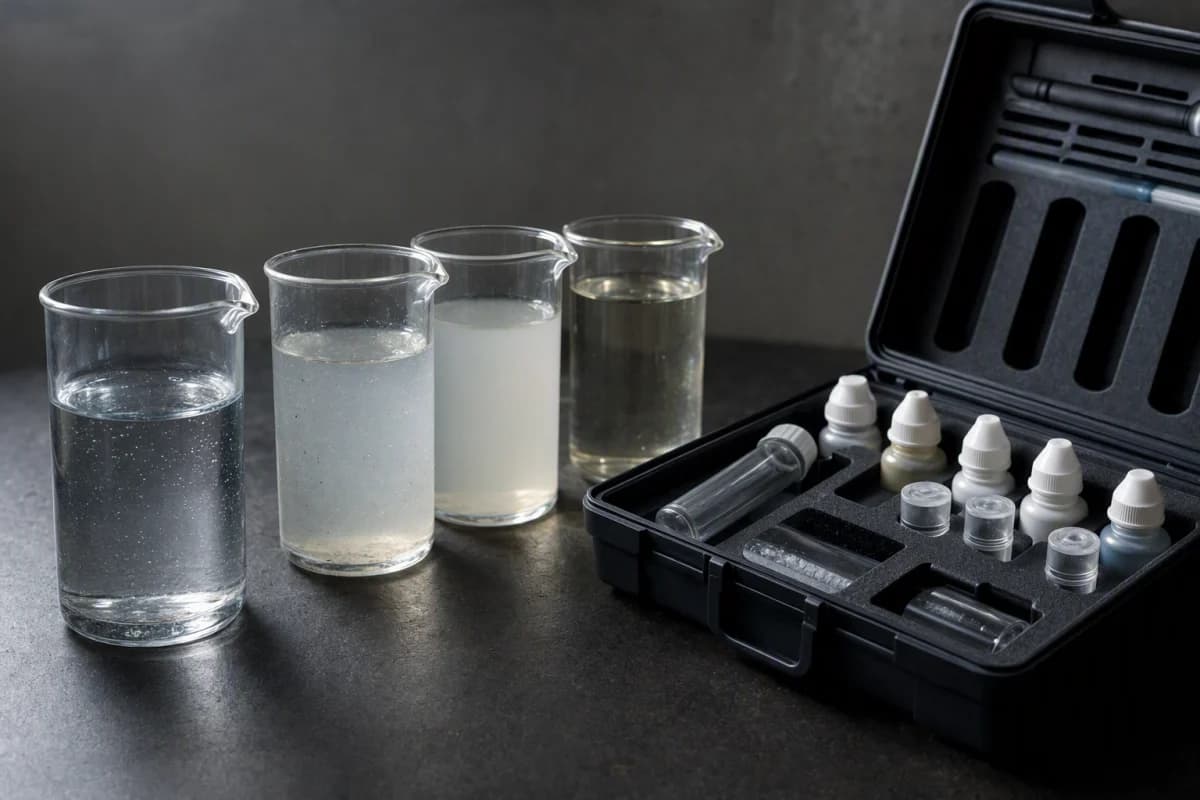
What to test, and when
A practical sequence for a site that is about to commission or top up a diluted charge:
| Test | Purpose | When |
|---|---|---|
| Conductivity | Total dissolved-ion screen; sets the achievable floor for low-conductivity grades | Every batch of dilution water |
| Chloride | Pitting risk on stainless and aluminium alloys | Before any large charge; on every new supply source |
| Total hardness | Scale potential in heat exchangers | Before any large charge |
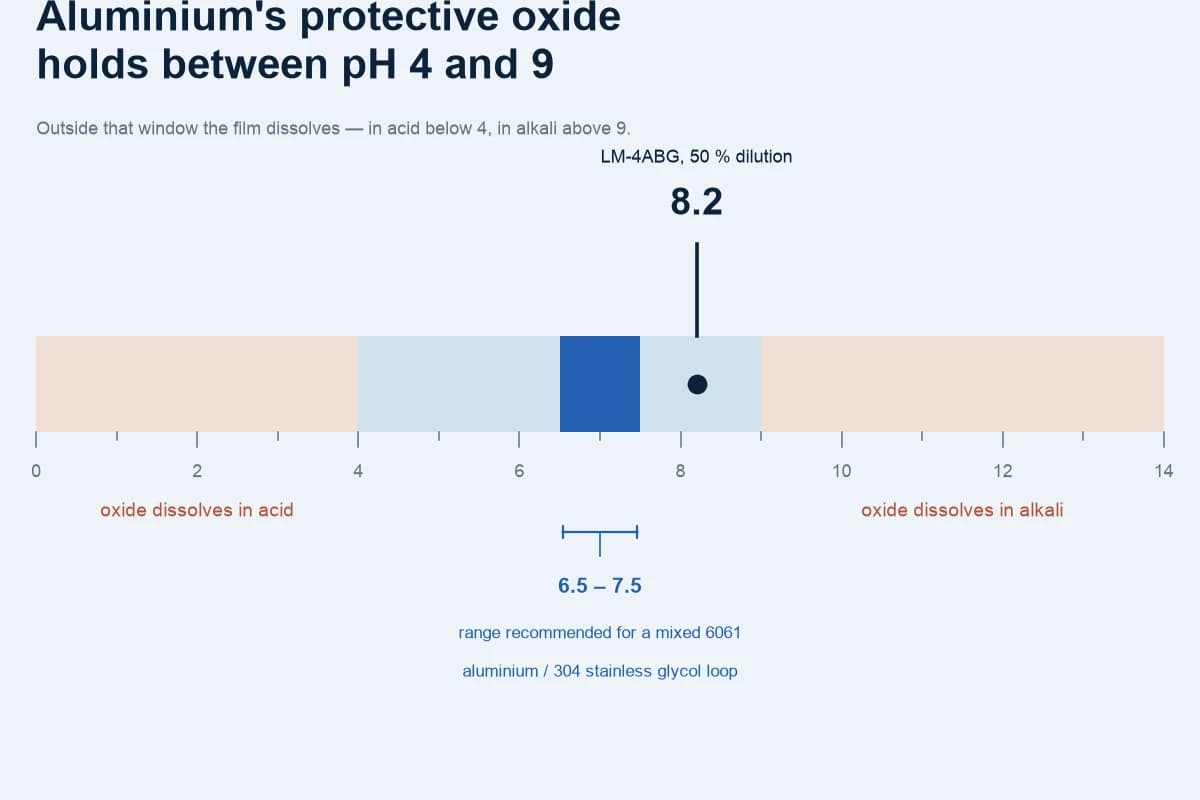
| pH | Checks the supply is not acidic or alkaline before it meets the inhibitor | Every batch |
Two practical notes. First, supplies vary: a municipal source can change seasonally, and a borehole can change after heavy rain. A reading taken once describes that day. Second, keep the result. A commissioning record that names the water source and its measured values gives you a baseline to compare against when conductivity drifts two years later — the same reasoning that makes a baseline sample of fresh fluid valuable.
Make-up is the same decision, repeated
The water question does not end at commissioning. Every top-up adds water, and plain water dilutes both glycol and inhibitor — the mechanism behind the concentration drift discussed in glycol freezing point versus burst point.
So the make-up policy is part of the specification, not an afterthought:
- State which water may be used for make-up, by the same criteria as the initial fill.
- State what is added when the level drops — water, or a pre-mixed charge at the operating concentration. Adding water to a loop that is simply low on level reduces concentration; adding a pre-mixed charge preserves it.
- Record every addition. Make-up history is the single most useful evidence when a concentration reading later looks wrong.
The maintenance routines in what to test and how often cover the monitoring side; the water policy covers what you are allowed to put in. For an existing loop that is already running on a fluid you did not specify, the system protection programmes set out the treatment routes that apply before any water is added.
Setting the water limits
A water specification for your loop — acceptable chloride, hardness and conductivity limits — depends on the alloys in your circuit, the operating temperature, the model and concentration you have chosen, and the consequence of a failure. Those limits belong in your project specification and in the current technical data sheet for the exact product — bring the supply analysis and the wetted-material list to your supplier and ask for the limits that apply.
QUICK CLARIFICATIONS
Common questions.
Can I use tap water if it is soft?
Soft is not the same as suitable. Domestic ion-exchange softening replaces calcium and magnesium with sodium, which reduces scale but does nothing about chloride — and the regeneration process can leave residual chloride in the supply. For a diluted coolant, what matters is the dissolved-ion content as a whole, measured as conductivity, plus chloride specifically. Test the actual supply rather than inferring quality from the word 'soft'.
How do I know what my supply contains?
Measure it. Conductivity is the fastest screen and a conductivity meter is inexpensive. Chloride and total hardness need a test kit or a laboratory. Because municipal and borehole supplies vary by source and season, a single reading describes that day; if you are commissioning a large charge, take a sample and keep the result with the commissioning record so a future drift can be compared against a known baseline.
Do I need ultrapure water for every model?
No. The ultrapure requirement attaches to the LM-4D grade, which is formulated for ultra-low conductivity. Most dilutable families state pure water. The distinction matters because water quality sets the conductivity floor: a high-conductivity supply will prevent a low-conductivity product from reaching its specified value, no matter how good the inhibitor package is. Confirm the requirement for the exact model before filling.
If the water is poor quality, can I compensate with more inhibitor?
Not reliably. Inhibitors are formulated against an expected water chemistry, and a charge made with high-chloride water starts with a corrosion risk that additional inhibitor does not necessarily remove — chloride pitting is a localised mechanism, not a general corrosion rate. The better answer is to treat or source the water, or to select a model and concentration suited to what is actually available on site.
CHECK THE SOURCE
References & scope.
- Glacier catalogue — LM-4D ultrapure-water dilution instruction (printed page 14)
- Glacier catalogue — LM-4D-YE pure-water dilution and three-month pH check (printed page 13)
- Glacier catalogue — LM-4A series dilution with pure water (printed page 16)
- Glacier catalogue — LMH brine inhibitor and chloride pitting control (printed page 29)
Obtain the relevant TDS, SDS and technical approval before use.
How we prepare our content