Low-conductivity coolants: what actually sets the number
Conductivity in a data-centre loop is set by the additive package and the dilution water. See how a sub-1 µS/cm fluid is built and how to hold it there.
THE SHORT ANSWER
What you need to know.
Conductivity measures the ionic content of the fluid, and ions are what carry stray currents between wetted metals. The ultra-low-conductivity grade is built around non-ionic additives with inorganic salts — nitrogen, phosphorus and silicon compounds — removed, arriving at a stock-solution figure below 1 µS/cm at 20 °C and below 5 µS/cm at 50% dilution. What matters for a real loop is that the dilution water can set a higher floor than the concentrate, so water quality and in-service monitoring decide whether the number holds.
- Conductivity is ionic content: it is set by the additive chemistry and by whatever water the charge is diluted with.
- The ultra-low-conductivity grade removes inorganic salt additives rather than adding an inhibitor to compensate for them.
- A number measured at 20 °C on stock solution describes a condition your loop spends no time at — monitor the trend in service.
The property that is really a measurement of everything dissolved
Ask what a coolant's conductivity is and the answer sounds like a single number. It is not. Conductivity is a proxy: it measures how well the fluid carries current, and in an aqueous coolant that is almost entirely a function of what is dissolved in it.
That matters because dissolved ions are mobile charge carriers. In a loop that passes near live electronics, or that contains several metals at different electrochemical potentials, ionic content gives stray current somewhere to go. The result is electrochemical corrosion — localised, and capable of perforating a cold plate rather than thinning it uniformly.
So a low-conductivity specification is really a specification about ionic content. Which raises the practical question: where do the ions come from, and what can you do about each source?
Source one: the additive package
Inhibitor chemistry usually involves inorganic salts. That is not a defect — inorganic inhibitors are effective and widely used. But salts ionise, and ionisation is exactly what raises conductivity.
The approach in the ultra-low-conductivity grade is to remove the salts rather than to compensate for them. LM-4D is described as adopting multi-functional organic non-ionic additives, with inorganic salts based on nitrogen, phosphorus and silicon eliminated. The stated purpose is threefold: to improve electrochemical antioxidant capability, to inhibit the tendency of the liquid to ionise, and thereby to reach very low conductivity.
The figures are:
| Condition | Conductivity |
|---|---|
| Stock solution at 20 °C | below 1 µS/cm |
| 50% dilution | below 5 µS/cm |
Two things are worth reading carefully here. First, the stock-solution figure is the more impressive one because it is measured on the product as supplied. Second, the 50% dilution figure is roughly five times higher than the stock figure — and the reason is the subject of the next section.
The same design intent appears in the LM-4D-YE grade, described as using non-ionic additives to replace inorganic salt components in order to reduce conductivity and enhance resistance to electrochemical corrosion, over a wider −35 °C to +130 °C window.
Source two: the dilution water — usually the binding constraint
This is the point that decides most real installations.
A diluted charge is mostly water. If that water carries ionic content, it sets a floor on the loop's conductivity that no concentrate rating can overcome. That is why this grade is specified for dilution with ultrapure water, and why the dilution-water question deserves more attention than it usually gets.
The practical test is straightforward: measure the conductivity of the dilution water before the charge is mixed. If the supply reads a meaningful fraction of your target, the concentrate's rating is academic. The same reasoning applies to every later top-up, because make-up water is how a carefully built charge drifts — the mechanisms are set out in what water to dilute coolant with.
Source three: what happens in service
Conductivity is not a fixed property of a charge. It moves.
- Make-up water with higher ionic content than the original charge raises it directly.
- Inhibitor depletion changes the ionic balance as the additive package is consumed.
- Corrosion products entering the fluid add dissolved material.
- System contamination — residues from installation, cleaning agents, seal leachate — contributes its own ions.
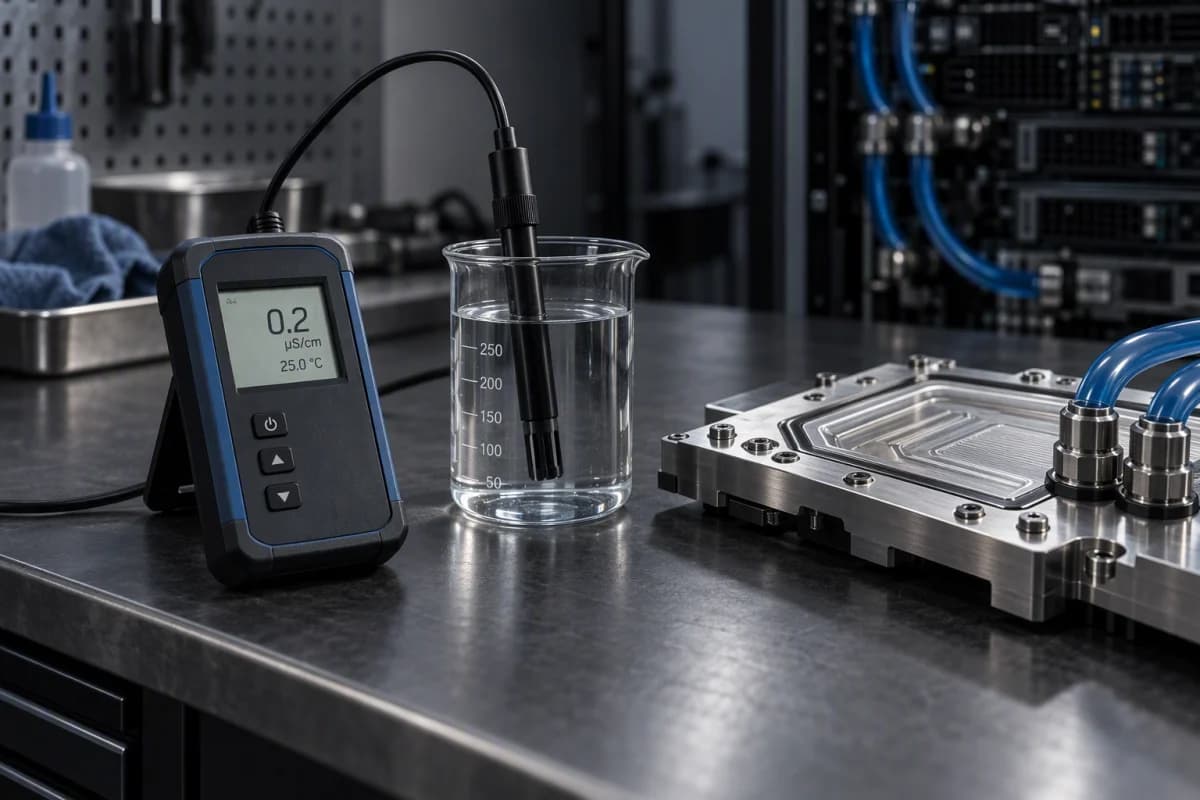
Because of this, for this grade the conductivity value and pH value are to be tested every three months, with contact for adjustment if conductivity rises above the specified value or pH falls below it. Those thresholds are model-specific and belong in the current technical data sheet.
The useful framing is the one that applies to any inhibited aqueous loop: a single reading inside range proves very little, and several readings showing a direction tell you a great deal. A baseline taken on fresh fluid is the record that makes the trend readable — the same principle that decides when TAN, pH and conductivity call for a change.
What else the grade covers
Low conductivity is one property. The grade is also described for corrosion protection across stainless steel, copper, brass and aluminium alloy, with an operating range of −35 °C to +100 °C. Losing corrosion protection to gain a low conductivity reading would not be a trade anyone wants, so the materials list belongs alongside the electrical figure in the specification.
For data-centre work specifically, the model table carries several grades annotated for that duty — including models in the −35 °C to +150 °C range with and without the low-conductivity additive approach. Which one applies depends on the loop architecture and the temperature window, not on the conductivity figure alone. See indirect liquid cooling versus immersion for how the architecture decides the fluid class.
Where this grade sits alongside immersion fluids
One boundary is worth stating plainly, because the two get conflated.
A low-conductivity indirect-loop fluid and an immersion fluid are specified for different contact conditions. The LM-17 series is described for server immersion, where the fluid contacts printed-circuit assemblies, solder, connectors and the full range of server materials directly. Its breakdown-voltage and pour-point data address that contact; the direct-to-chip loop fluid addresses a different set of risks.
An indirect-loop fluid with low conductivity has not been assessed for long-term contact with those assemblies, and the available information does not support substituting one for the other.
What to specify
For a direct-to-chip or low-conductivity loop, the specification work comes down to five things:
- The target conductivity and its basis — stock solution or operating concentration, and at what temperature.
- The dilution and make-up water — the maximum ionic content permitted, tested before the charge is mixed and before every top-up.
- The interval and action threshold — conductivity and pH at a stated frequency, with a defined trigger for intervention.
- The wetted materials, by grade, including the aluminium alloy actually in the cold plates.
- The current TDS and SDS for the exact model, with the conductivity figure stated on the same basis.
Point 2 is the one most often left implicit, and it is the one that decides whether the first four hold.
The data centres and electronics solution page sets out the architecture routes, and you can request model-specific documentation for the exact grade rather than the family.
Setting the conductivity limit
A conductivity limit for your loop depends on the loop voltage, the materials in contact, the consequence of a leak, and the grade chosen — and it belongs in the project specification and the current technical data sheet for the exact model. Bring the loop architecture, the wetted materials and the water analysis to your supplier, and ask for the limit and the monitoring interval that apply.
QUICK CLARIFICATIONS
Common questions.
Why does conductivity matter in a cooling loop at all?
Because dissolved ions are charge carriers. In a loop where fluid passes close to live electronics or sits between metals at different potentials, ionic content gives stray current a path. That drives electrochemical corrosion, which is localised and can perforate a cold plate rather than thinning it evenly. Low conductivity does not make a fluid an insulator — it reduces the ionic pathway, and it is one property among several that a direct-to-chip or immersion specification has to cover.
The concentrate is rated below 1 µS/cm. Will my loop hold that?
Only if the whole charge is built to it. A diluted charge is mostly water, and ordinary water carries far more ionic content than the concentrate. That is why this grade requires dilution with ultrapure water. If the make-up water is not controlled, the loop's conductivity will sit at whatever the water sets, regardless of the concentrate's rating.
What makes conductivity rise after commissioning?
Anything that adds ions or dissolves material: make-up water with higher ionic content than the original charge, inhibitor depletion, corrosion products entering the fluid, and contamination from the system itself. This is why conductivity should be tested on an interval rather than once at fill, and why a baseline reading taken on fresh fluid is the most useful record the site will hold.
Does a low-conductivity grade replace an immersion fluid?
No. They are specified for different contact conditions. The LM-4D grade is an indirect-loop fluid formulated for low ionic content, while the LM-17 series is described for server immersion, where the fluid contacts printed-circuit assemblies and the full range of server materials directly.
CHECK THE SOURCE
References & scope.
- Glacier catalogue — LM-4D ultra-low-conductivity grade, composition and conductivity figures (printed page 13)
- Glacier catalogue — LM-4D ultrapure dilution and three-month conductivity check (printed page 14)
- Glacier catalogue — LM-4 series model table, including data-centre grades (Table 4)
- Glacier catalogue — LM-17 dielectric immersion fluids (Table 15)
Obtain the relevant TDS, SDS and technical approval before use.
How we prepare our content