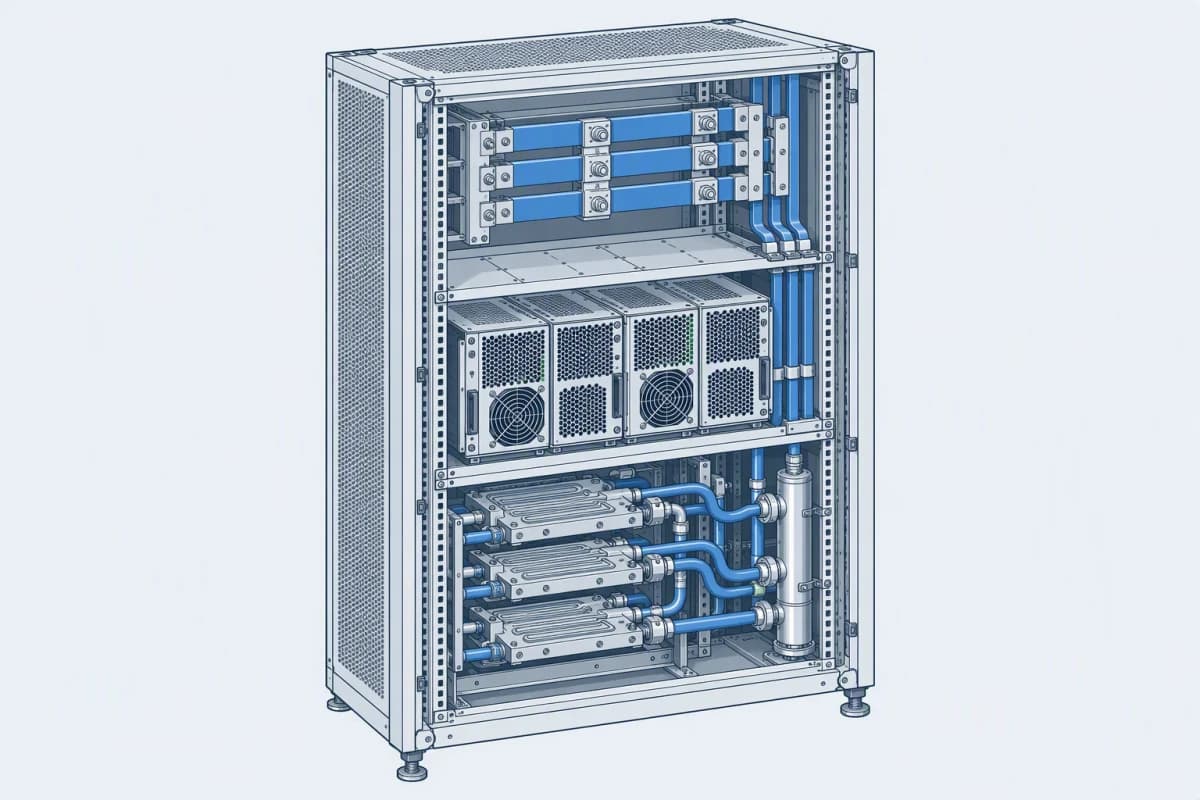
Water, not heat, is the Gulf data centre constraint
In the Gulf the binding constraint on cooling is water, not air temperature. See why the three water routes cost what they do, and where a closed loop fits.
THE SHORT ANSWER
What you need to know.
In the Gulf the binding constraint on data centre cooling is water, and it is availability and permission before it is price. Evaporating water at 30 °C absorbs about 2,430 kJ/kg, so rejecting one kWh of heat sheds roughly 1.5 litres at the latent-heat limit. On price alone that is a fraction of the extra electricity a dry route burns through the summer peak, so tariffs rarely flip the choice by themselves — what binds is whether a site can secure a non-potable supply, obtain consents, and meet its own water-neutrality commitments.
- The Gulf constraint is water availability and permission rather than water price; tariffs rarely flip the choice on their own.
- Seawater and treated sewage effluent are both viable, and each carries an infrastructure penalty — titanium wetted parts or heavy filtration — that belongs in the capital column.
- Evaporative cooling sheds roughly 1.5 litres of water per kWh of heat rejected at the latent-heat limit, and a real tower runs somewhat below that depending on climate and air flow.
- A closed loop is filled once; its consumption is make-up, not evaporation, which is what changes its position against the alternatives — and its cost appears as electricity and capital instead.
1. The constraint is water
Data centre cooling in northern Europe is a problem about heat: how to reject it, and how much energy that takes. In the Gulf it is a problem about water, and the difference is not a matter of degree.
Two facts set the frame. Summer daytime temperatures across the Gulf exceed 40 °C from about June to September — Riyadh averages around 44 °C in July and Dubai around 41 °C in August, while coastal Jeddah stays just below 40 °C on a monthly mean — so a route that depends on air alone cannot carry the summer peak without either a mechanical refrigeration stage or a much larger heat exchanger. Dry rejection remains workable outside those months. And the routes that avoid that dependence — evaporative cooling in its various forms — consume water continuously, in proportion to the heat they reject.
As of September 2026 the regional numbers make the second point concrete. Data centre water consumption across the Middle East and Africa is estimated at about 119 billion litres in 2025 and about 153 billion litres in 2026, with the Gulf Cooperation Council accounting for roughly 48 % of the 2025 figure, and the forecast for 2031 is above 535 billion litres. Those figures are estimates and they will move, but the direction is not in question: cooling water demand in the region is rising with the build-out rather than being designed out of it.

2. Three water routes, and what each costs
Where a site gets its water is a design decision with a price attached, and the published tariffs for Saudi industrial projects illustrate the spread:
| Source | Indicative tariff | What it implies |
|---|---|---|
| Industrial potable water | 8.04 SAR/m³ (Jubail and Yanbu projects, announced December 2025) | Continuous consumption is a policy question as much as a cost one |
| Treated sewage effluent | ~3.00 SAR/m³ | Viable, but needs heavy filtration |
| Seawater | 0.069 SAR/m³ | Viable at scale, with titanium wetted parts |
The three rates are not the same kind of number, and the difference matters. The potable and seawater figures come from the same announced tariff schedule for the Jubail and Yanbu industrial cities — 8.04 SAR/m³ for industrial water and 69.16 SAR per 1,000 m³ for seawater cooling — so both are real rates rather than models. The seawater line only applies to a site that already has a seawater cooling connection with intake and discharge consents, which is what limits it rather than its price. The effluent rate is different: it comes from a single industry report rather than from an announced tariff, so treat it as an indicator of the structure of the comparison rather than as a rate to enter into a model.
The regional consumption volumes quoted above come from a commercial market model rather than from metered consumption, and are best read as a direction of travel.
And raw seawater cannot go into a cooling tower. It has to be desalinated first, which puts it in the range of a few riyals per cubic metre rather than a few halalas. So the ratio that matters for an evaporative comparison is the potable rate against the treated alternatives — against effluent at around 3.00 SAR/m³, that is roughly 2.7 times, not two orders of magnitude. The very wide ratio is between potable water and seawater taken for once-through cooling — a real tariff line, but one that only exists where the site already has a seawater intake — so it belongs in a seawater-route comparison rather than in an evaporative one.
An evaporative system's water consumption does scale with the heat it rejects — the water leaves as vapour and has to be replaced continuously. What that costs depends on which water it is allowed to use.
What evaporation costs per unit of heat
A tariff cannot be applied to anything until there is a consumption figure to apply it to, and for evaporative cooling that figure follows from the latent heat of water rather than from any particular tower design.
Vaporising water at around 30 °C absorbs roughly 2,430 kJ per kilogram. Rejecting one kilowatt-hour of heat means moving 3,600 kJ, so the water that has to leave the system as vapour is:
3,600 ÷ 2,430 ≈ 1.5 kg per kWh of heat rejected
That is the latent-heat requirement: the water that has to leave as vapour to carry the heat away, whatever the tower is made of. Total make-up is higher, because a cooling tower also loses water to blowdown — the bleed that keeps dissolved solids from concentrating — and to drift, and the blowdown fraction depends on the cycles of concentration the site runs at. A tower might therefore draw two to three litres per kWh of heat rejected, but evaporation sets the larger part of that draw, and the blowdown fraction is the part a site can control.
Applying the industrial tariff from the table:
| Per kWh of heat rejected | |
|---|---|
| Water evaporated | ~1.5 L |
| Water cost at 8.04 SAR/m³ | ~0.012 SAR |
That is per kWh of heat rejected, which is not the same denominator as a published water usage effectiveness figure. Facility heat rejection is roughly IT load multiplied by the power usage effectiveness, so a figure of this kind converts to something in the region of 2 litres per kWh of IT load at typical efficiency — the same order as the figures operators report publicly, which are quoted per kWh of IT load.
That figure is what makes the water cost comparable with anything, and it also shows why water price alone does not settle the choice. It is a cost per kilowatt-hour of heat rejected, so before it can be set against an electricity price it has to be converted through the heat rejection ratio. Taking a plant that rejects 1.25 kWh of heat per kWh of IT load, the water cost becomes 1.25 times the figure above when expressed per kWh of IT load, and the comparison is then against the extra electricity a dry route spends per kWh of IT load in the summer peak.
Done that way, the water cost is small against the electricity a dry route burns when it needs a mechanical refrigeration stage. At a published Saudi tariff of 18 halalas/kWh — the cloud computing rate, and the rate the heavy-consumption tariff sets for eligible industrial sites on the distribution network, against a general industrial rate of 20 halalas and 32 halalas for the commercial tier above 6,000 kWh a month — and with a mechanical stage at a coefficient of performance near 3, that electricity comes to about 0.06 SAR per kWh of heat rejected. Against it, the evaporated water costs about 0.012 SAR, or about 0.018 SAR for total make-up at three cycles of concentration: a difference of roughly three to five times. Where a site can meet its peak by oversizing the dry cooler and running more fan power instead, the electricity figure falls to under a halala and the two costs come within the same order of magnitude. On price alone, evaporative cooling generally still wins; the margin depends on how much mechanical refrigeration the site actually avoids. The electricity tariff figures are from the Saudi schedule in force since May 2025.
What actually constrains the choice is availability and permission, not price. In a region where water is a policy subject, the limits that bind are whether a site can secure a non-potable supply at all, whether it can obtain intake and discharge consents, and whether the operator's own water-neutrality or net-zero commitments permit continuous consumption. Those are not tariffs, and they do not appear on a cost comparison at all. That is the sense in which water is the constraint: it is a permission and a commitment before it is a price.
Humidity moves the figure, and in this region it moves it in the direction that matters. The 1.5 litres is a latent-heat benchmark — what the evaporation would be if all the rejected heat left as latent heat. A real tower transfers part of the heat as sensible heat, and the split depends on the inlet air: evaporation from a cooling tower is set by the difference in moisture content between the incoming and outgoing air, so dry inlet air at a given heat load evaporates more, not less. A mass balance for Riyadh's summer conditions puts a real tower at about 1.4 litres per kWh of heat rejected, a humid coastal site lower, and a temperate site at around 1.2. Across the range of latent-heat fractions reported in cooling-tower engineering practice — between 60 and 95 per cent of total heat rejection, varying with cooling range, air flow and inlet conditions — the resulting water figure spans about 0.9 to 1.4 litres per kWh of heat rejected, a spread of roughly twenty per cent around the midpoint.
Two consequences follow. The benchmark is not a floor that equipment cannot move — the sensible and latent shares can be shifted by air flow, at a cost in fan power, which is how a tower's water draw can be reduced at the design stage. And at inland Gulf sites the summer air is dry, so the actual figure sits at the high end of that range — while a humid coastal site such as Dubai or Doha sits lower. The estimate of about 1.5 litres is therefore a reasonable working number for this region, but it is reasonable because of the local climate rather than because physics pins it there.
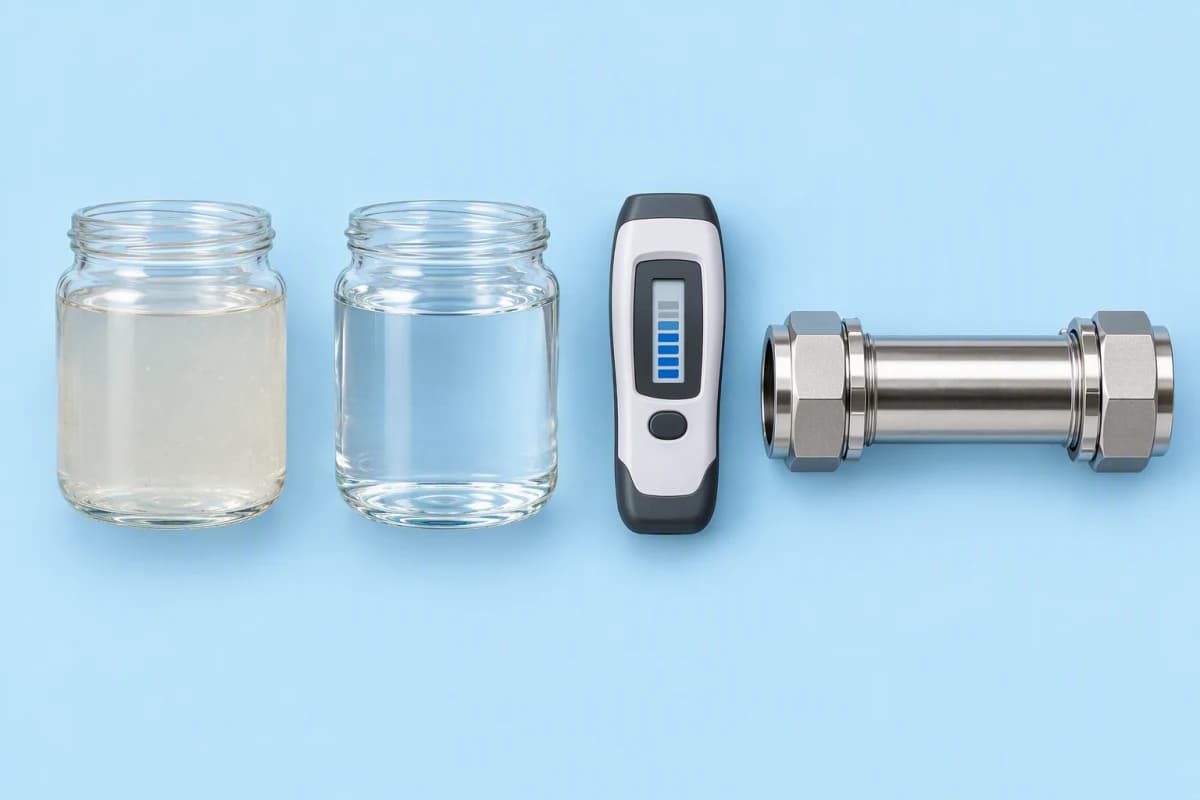
The cheap routes are not free routes. Seawater at 0.069 SAR/m³ is attractive until the materials are counted: seawater is aggressive to most common metals, and a seawater-cooled circuit needs titanium or an equivalent for every wetted part, which is a capital cost in a different budget line from the water itself. Treated effluent at around 3.00 SAR/m³ avoids that, and substitutes its own requirement — heavy filtration and a treatment programme, because effluent quality varies and carries its own fouling and biological load.
3. What a closed loop actually consumes
This is where a secondary coolant loop changes the arithmetic, and it is worth being precise rather than enthusiastic about it.
A closed liquid loop is filled at commissioning and then topped up, not evaporated. The water in it stays in it. Consumption is make-up: small leaks, sample volumes, fluid carried out on a filter element during maintenance. That consumption does not scale with the heat the loop carries, which is the structural difference from an evaporative route. A water-diluted charge is the usual case, and its water is a fill rather than a fuel — see what water to dilute coolant with for how the make-up specification is set.
An evaporative system consumes water in proportion to heat rejected, because evaporation is how it rejects the heat. Its water demand is tied to the load, and it therefore behaves like a fuel rather than like a fill.
The comparison is between a cost that varies with the plant's duty and a cost that is essentially fixed at commissioning. In a market where water is the scarce input, that is the whole argument — and it holds regardless of which fluid the closed loop contains.
Three qualifications keep it honest.
A closed loop still needs to reject its heat somewhere. Closing the loop does not remove the heat-rejection problem; it moves it to a dry cooler, a chiller or a seawater exchanger. Where that rejection is itself evaporative, the water consumption has not been eliminated, only relocated out of the loop. The saving comes from the loop being closed, not from liquid cooling as such.
A closed loop does not make the heat go away, and rejecting it in this climate costs power. This is the counterweight to everything above, and it belongs in the same comparison. A closed loop rejects its heat through a dry cooler, a chiller, or a seawater exchanger. Once ambient passes roughly 40 °C, a dry cooler cannot reach the fluid temperatures a dense rack needs without either a very small approach — which means a large heat exchanger and high fan power — or a mechanical refrigeration stage, which means a compressor running through the summer peak. The water saving is real; it is bought with electricity and with capital, and the honest way to present the choice is as a trade between the two rather than as a saving.
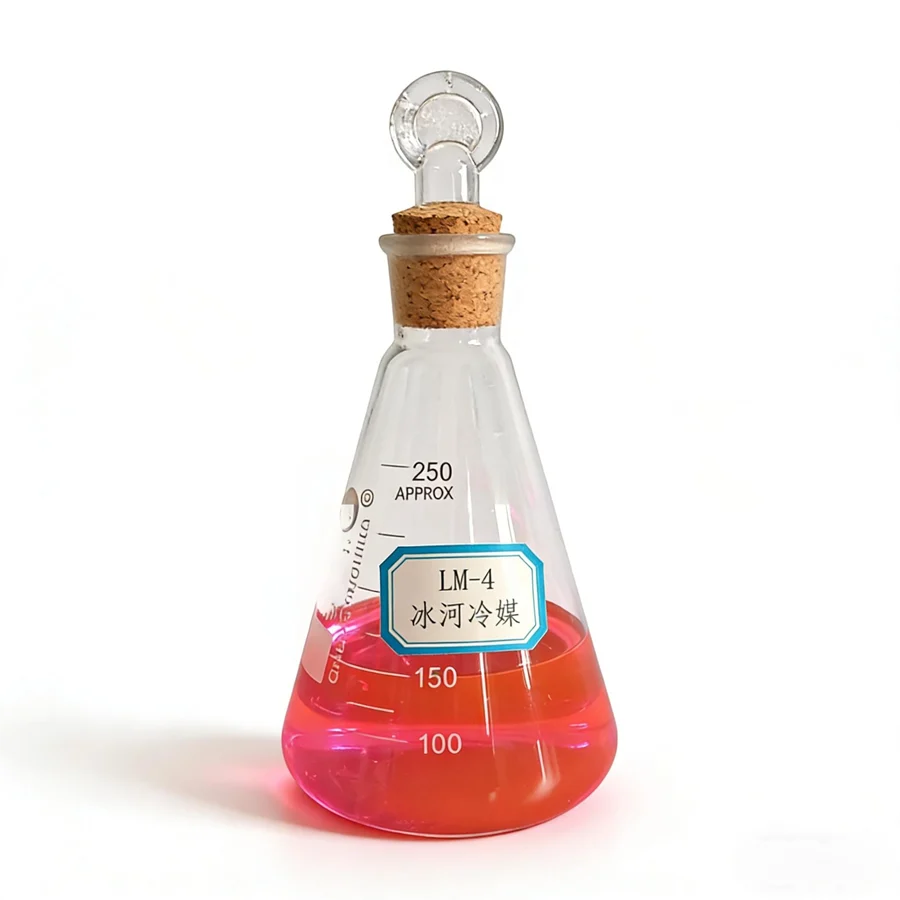
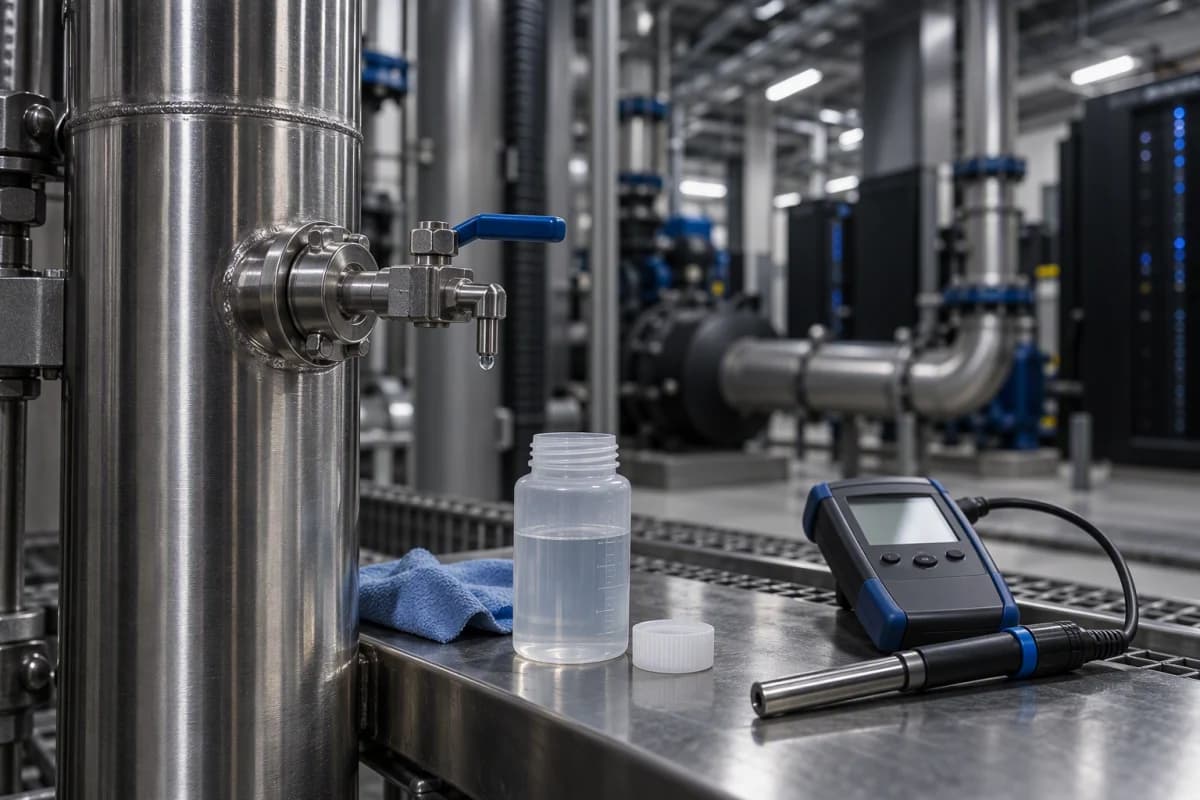
The top-up water still has to meet the specification. A closed loop consumes little water, but what it does consume goes into the fluid. Where the fluid has a conductivity requirement — as in a high-voltage rack — the make-up water sets a floor that the loop cannot go below, and a site whose available water is high in dissolved solids has to treat it or accept a higher reading. The LM-4D grade — the ultra-low-conductivity model in the glycol-type range — illustrates how far that can go: it is specified for dilution with ultrapure water, which is a water-treatment requirement created by the fluid specification rather than by the climate.
4. Why the fluid choice follows the water choice
Once the water constraint is understood, the fluid question becomes narrower and more concrete.
Where the available water is good, a water-diluted glycol is the straightforward choice: it is filled once, topped up rarely, and the dilution water quality is a specification item rather than a cost. Most Gulf sites that have secured a good water source fall here.
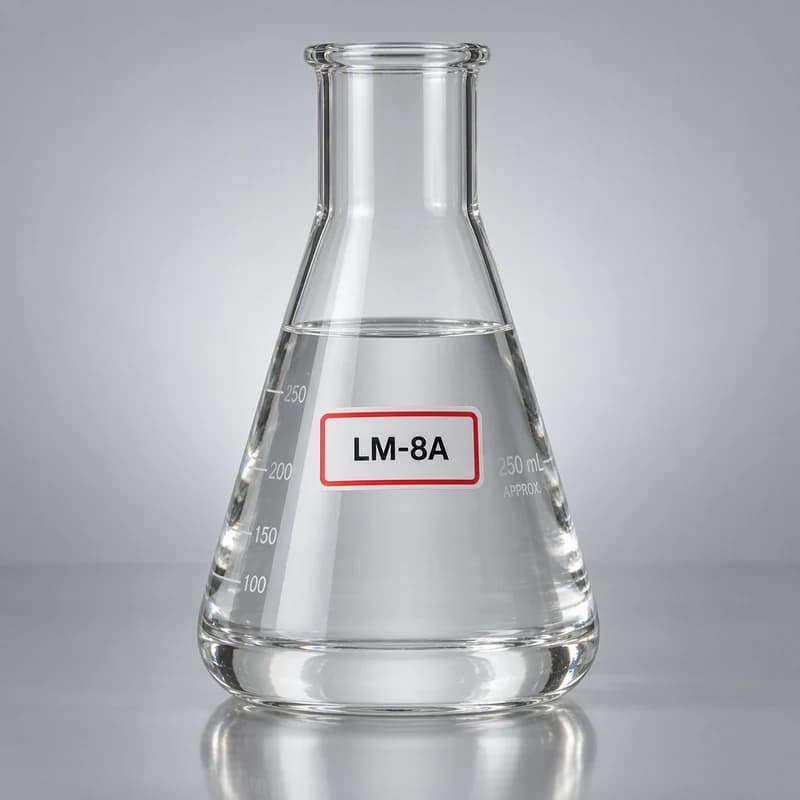
Where the water is aggressive or variable, the argument for a fluid that is less sensitive to dilution quality gets stronger. The LM-8A inorganic salt secondary refrigerant, for instance, is supplied ready to use rather than diluted on site — the instruction is to add the stock solution directly — which removes the make-up water variable from the loop. It comes with its own conditions: the compatible-metals list does not include aluminium, and the programme calls for periodic replenishment of the LMH corrosion inhibitor rather than a fill-and-forget charge. That trade is worth pricing rather than assuming.
Where the loop has to run through a hot ambient, the fluid's own temperature window and its viscosity at the warmest condition matter more than they would in a temperate site. Seawater-cooled heat rejection may run at a temperature a dry cooler could never reach, which changes the loop's operating point rather than just its water source.
The sourcing question and the fluid question are the same question asked at different points: what does the site have, and what can the fluid tolerate.
5. What to establish before specifying
Five items, and the first two are usually settled by the site rather than by the project:
- The water source and its tariff, as a per-cubic-metre figure rather than a qualitative description — and which sources the site is actually permitted to use, which usually matters more than the price.
- How much water each candidate cooling route consumes, expressed per unit of heat rejected. For evaporative cooling that figure follows from latent heat and is roughly 1.5 litres per kWh before blowdown; for a closed loop it is the make-up rate, which is orders of magnitude smaller and has to be estimated from the site rather than from the fluid.
- The achievable make-up water quality, and whether treatment is required — which sets the conductivity floor a closed loop can hold.
- The electricity a non-evaporative route would spend to reject the same heat through the summer peak, against the local power tariff. This is the other side of the comparison, and it is the side that decides the outcome on cost.
- The materials the chosen water source will touch, which for seawater means the whole wetted circuit and not just the exchanger.
Those five determine whether the water constraint is solved, relocated or merely deferred.
6. Limitations
The tariff figures are project-specific and dated. The rates above come from published sources for particular Saudi projects rather than universal rates, and water tariffs are policy instruments that get revised. They illustrate the structure of the comparison, not a given site's economics.
The consumption forecasts are estimates. Regional water-consumption projections vary with the build-out they assume, and the figures here should be read as a direction rather than a schedule.
No site-specific engineering assessment is implied. Whether a given project can take seawater, effluent or neither depends on consents, proximity, geology and local regulation, none of which is evaluated here.
Material requirements for seawater are stated qualitatively. Titanium or an equivalent is the usual answer for wetted parts, but the specific alloy and the full wetted-material list are decisions for the equipment supplier against the actual water analysis.
No independent measurement was made. Product figures are reference values published by the manufacturer, and no independent testing or third-party endorsement is implied.
7. Where the water argument lands
The Gulf's cooling problem is usually described in terms of temperature, and that description misses the design lever. Ambient temperature is what rules out dry rejection through the summer months; what the remaining routes consume is water, and it is that consumption — rather than its price — that a closed loop changes.
That does not make a closed loop the right answer everywhere in the region. It makes the water consumption of each candidate route a figure the design has to carry, and it puts the fluid question downstream of the water question rather than alongside it. A site that has secured cheap seawater is making a different decision from one paying industrial potable rates, and both are making a different decision from one with no non-potable source at all.
Bring the water tariff, the make-up water analysis and the heat-rejection route to your supplier. Those three determine which fluid options are open, and they are answerable from the site rather than from a datasheet.
QUICK CLARIFICATIONS
Common questions.
Does the ambient temperature matter at all if water is the real constraint?
It matters, and it is what makes water the constraint. Summer daytime temperatures across the Gulf stay above 40 °C from about June to September — with coastal Jeddah as the exception, staying just below — and through those months the heat cannot be rejected to air at any useful approach temperature without a mechanical refrigeration stage — so the choice narrows to something evaporative or something with that stage. Evaporative cooling then consumes water continuously, and it is that consumption rather than the temperature itself that sets the operating cost.
Does a closed liquid loop use no water at all?
It uses very little, which is not the same as none. A closed loop is filled once at commissioning and then topped up only to replace losses — small leaks, sampling, water carried out during maintenance. It does not evaporate the working fluid, because the fluid is not the thing being evaporated. The distinction that matters is between a cooling route whose water consumption scales with the heat rejected and one whose consumption is a rounding error on the fill volume.
Is seawater cooling realistic, or is it a pilot-stage idea?
It is in construction. Seawater cooling carries its own published tariff line in the Jubail and Yanbu industrial cities, set far below the industrial potable rate, which is what makes liquid-to-liquid seawater cooling viable at scale. What limits it is the connection rather than the price. The penalty is materials — seawater is aggressive, and titanium or equivalent wetted parts are not optional. Whether it applies to a given site depends on proximity to the sea and on the intake and discharge consents.
What about treated sewage effluent?
It is a real route and it sits between the other two on cost. It is cheaper than industrial potable water and far more expensive than seawater where seawater is available, and it needs heavy filtration and a water treatment programme of its own. For a site without a sea connection it is often the only non-potable option, which makes it worth costing even where it does not look attractive on the headline tariff.
CHECK THE SOURCE
References & scope.
- Mordor Intelligence — data centre water consumption in the Middle East and Africa, by volume and forecast
- PDH Online — Cooling Towers: Basic Calculations, on the share of heat rejection carried by evaporation and the factors it varies with
- Saudi Electricity Company — published consumption tariffs by customer category, including industrial, commercial and cloud computing
- Zawya / Argaam — Marafiq revises industrial water tariffs for Jubail and Yanbu, effective 7 December 2025, including the seawater cooling line
- Energy Solutions — Gulf liquid cooling localisation report, including effluent and seawater route economics
- Glacier catalogue — LM-4D ultrapure-water dilution instruction and conductivity figures (printed pages 13–14)
- Glacier catalogue — LM-8A inorganic salt secondary refrigerant (printed page 22)
Obtain the relevant TDS, SDS and technical approval before use.
How we prepare our content