Data centre cooling loops: the maintenance programme
A data centre loop cannot be taken offline for a fluid check on a whim. See which parameters to trend, why conductivity leads, and what belongs in the plan.
THE SHORT ANSWER
What you need to know.
A data centre loop is monitored rather than serviced: interventions are expensive and usually require the loop to keep running. That makes trended parameters more useful than pass-or-fail limits. Conductivity and pH lead, because they are measurable in minutes and move before failures do. Around them sit the things a plan has to name — the sampling point, the interval, the action threshold and who acts on it. The exact interval depends on the site, the equipment vendor's requirements and the criticality of the load.
- Trends beat thresholds: a direction across several readings tells you more than one number inside range.
- Conductivity and pH are the practical leading indicators, and both can be measured without draining the loop.
- Particle control matters more here than in a process loop, because cold plates have narrow channels.
Why this loop is different
A process cooling loop can usually be taken out of service. A data centre loop generally cannot — not without interrupting the load it exists to protect.
That single fact reshapes the maintenance approach. In a process plant, the plan can include draining, flushing and refilling on a schedule. In a data centre, the objective is to avoid ever needing to, because the intervention costs more than the fluid does.
So the programme is built around monitoring: parameters that can be read without opening the loop, trended over time, with a defined response when they move. The question is not "is the fluid within specification today" but "is it heading anywhere".
Conductivity leads
For an aqueous loop, conductivity is the most practical leading indicator, for three reasons.
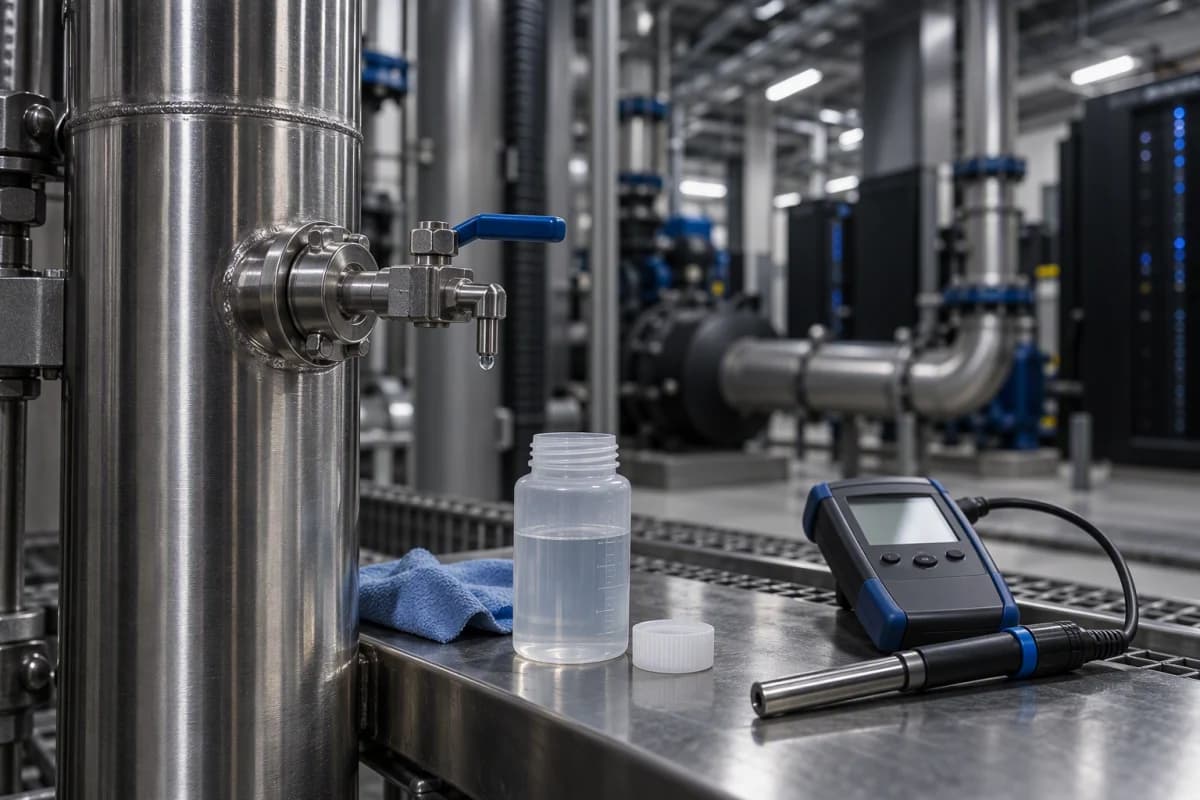
It is fast to measure. A sample from a sampling point takes minutes, not a laboratory turnaround.
It needs no intervention. You draw a small volume and return it, or read from an installed sensor. The loop keeps running.
It moves early. Conductivity responds to dissolved ionic content, and that content rises as inhibitor is consumed and as contamination enters. The direction is informative even when the absolute number is unremarkable.
In a low-conductivity installation it carries extra weight, because the whole specification is built around it. LM-4D — the ultra-low-conductivity grade, built on non-ionic additives rather than inorganic salts — carries a stock-solution figure below 1 µS/cm at 20 °C and below 5 µS/cm at 50 % dilution. The interval stated for that grade in the 2026-08 product data is three months for both conductivity and pH, with contact for adjustment if conductivity rises above the specified value. The threshold itself is model-specific and belongs in the current technical data sheet.
pH sits alongside it, for a different reason: it indicates the chemical state of the fluid rather than its ionic load. A falling pH is a condition to act on. The same interval applies to both, and reading them together is what makes a trend interpretable — the mechanisms behind both are set out in when to change a coolant.
Particles matter more here
This is the parameter that distinguishes a server loop from a general process loop.
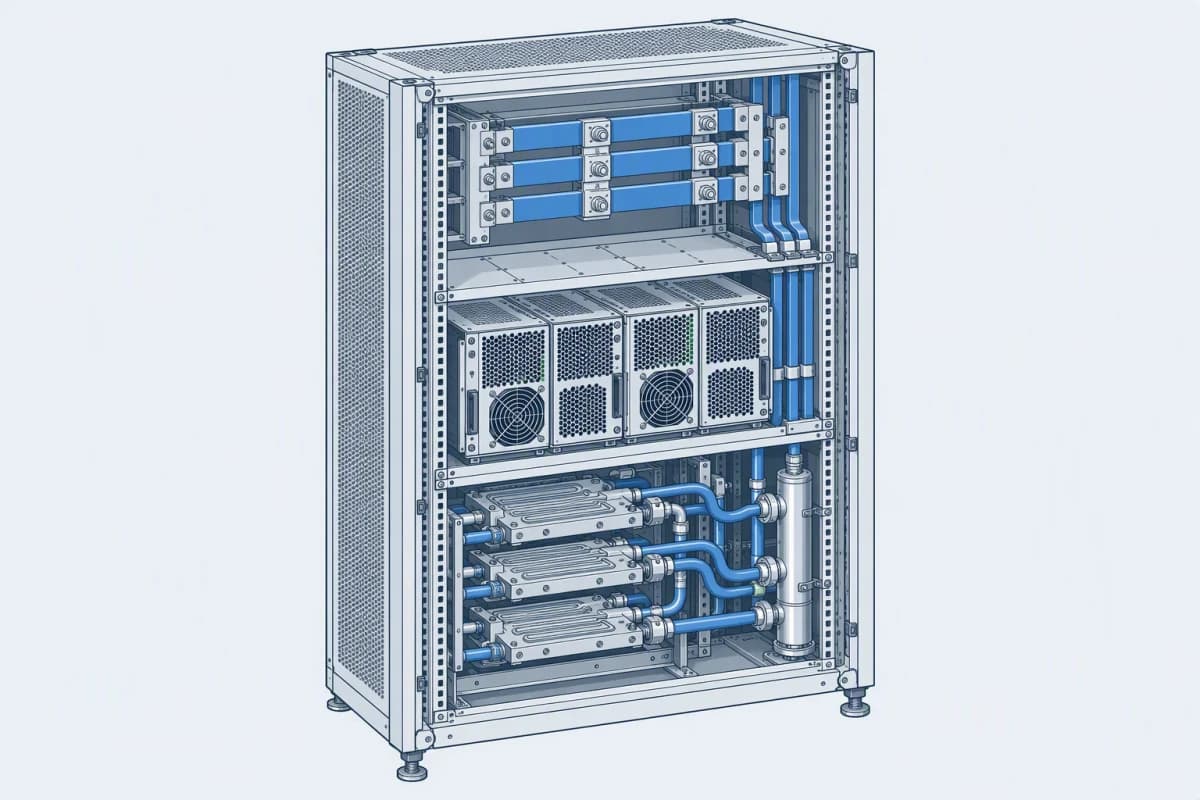
Cold plates and microchannel cold plates have narrow internal passages. A particle that would circulate harmlessly through a 100 mm process main can lodge in a cold plate and begin to restrict flow — and the restriction develops gradually, showing up as a rising approach temperature rather than as an alarm.
That is the argument for treating approach temperature as a monitored parameter in its own right, alongside the fluid chemistry. It is the earliest visible sign of a developing restriction, and it costs nothing extra to record alongside the readings you are already taking.
The practical controls are unglamorous:
- Commissioning cleanliness. A loop assembled and then flushed inadequately will carry installation debris into the cold plates. This is the largest single contributor, and the hardest to correct later.
- Filtration, where the equipment vendor specifies it. Filter selection and placement are the vendor's call, not a fluid decision.
- Preventing ingress. Every opening — a sample point, a top-up connection, a filter change — is an opportunity for debris and air to enter. The fewer unnecessary openings, the better.
There is no universal particle limit to quote here. What can be said is that particle control belongs in the plan, and that it is cheaper to design in than to retrofit.
Microbiological control
Warm, wet, continuously circulating fluid is a favourable environment for microbial growth, and a data centre loop has all three conditions.
The biocide is part of the fluid's additive package, so control begins with specifying a fluid that includes one and then maintaining the concentration. Two practical consequences follow.
First, biocide depletes, like every other additive. A loop that is never topped up will eventually have less biocide than it started with. This is one reason a "closed" loop is not a maintenance-free one.
Second, microbial growth is often visible before it is measurable. Colour, clarity, odour and any biofilm at a sight glass or sampling point are free evidence. A monitoring plan that only records numbers misses what an operator notices.
Make-up water is the biggest single risk
If there is one action most likely to undo a carefully commissioned low-conductivity loop, it is topping up with whatever water is nearest.
Make-up water carries dissolved ions, and in a loop specified below 5 µS/cm at 50 % dilution, the water's contribution dominates. It also carries chloride, which pits stainless steel and aluminium — the materials a cold plate is most likely to be made from.
The plan should therefore state, in advance:
- Which water may be used, with the same limits as the original charge.
- What is added when the level drops — water, or pre-mixed fluid at the operating concentration. These are not equivalent, and the difference matters to concentration as well as to conductivity.
- Who authorises an addition, and where it is recorded.
The wider question of what makes water suitable is covered in what water to dilute coolant with.
Instruments and sampling discipline
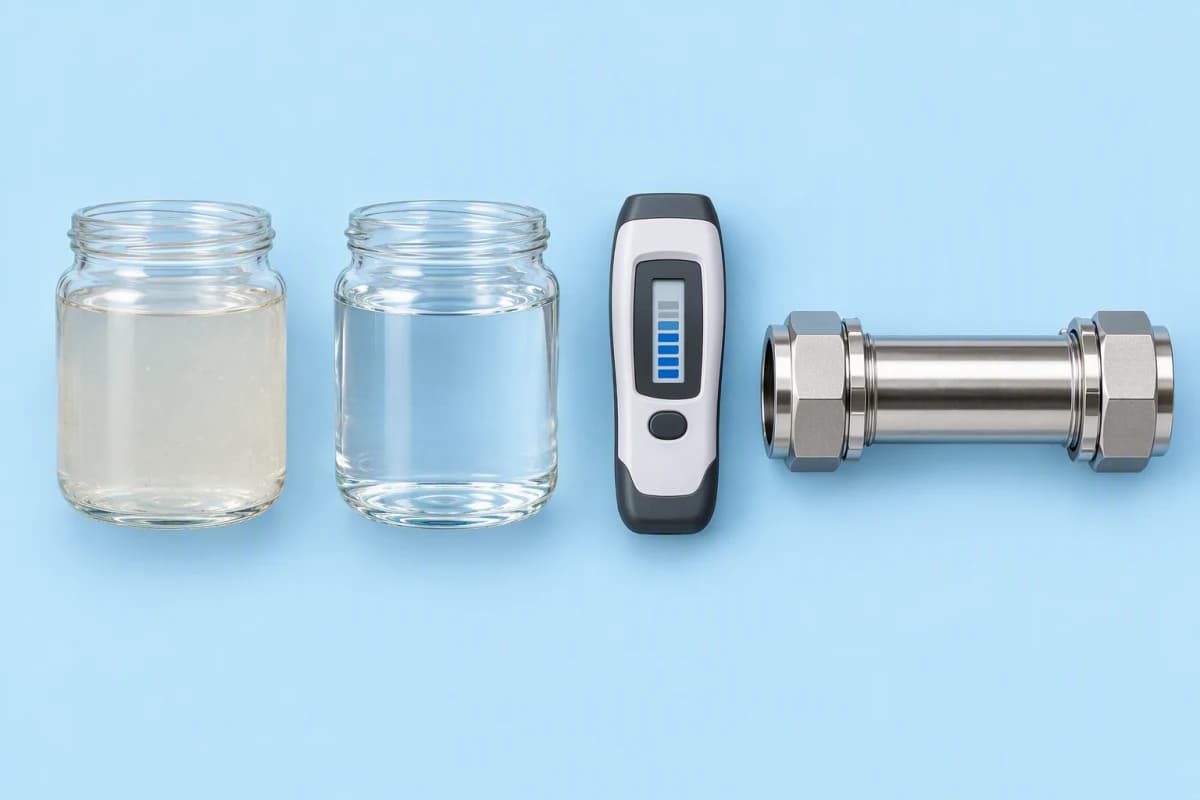
Two loops can show different readings because the fluids differ, or because the measurement did. Keeping the method constant is what makes a trend readable:
- Sample from the same point, in the same part of the circuit, at the same stage of operation.
- Use the same instrument, calibrated, and record which one was used.
- Record temperature alongside conductivity, because conductivity is temperature-dependent.
- Log the reading with its date and keep the series, not just the latest value.
A single reading inside range proves very little. Four readings showing a direction tells you when to act — and the value of that series depends entirely on the readings being comparable.
Five things a plan has to name
A plan that says "monitor the coolant" is not a plan. Five things make it one:
| Element | What it has to state | Worked example |
|---|---|---|
| Parameter | What is measured | Conductivity and pH |
| Method and point | How, and from where | Handheld meter at the return-line sampling valve |
| Interval | How often | Agreed with the equipment vendor at commissioning |
| Action threshold | The reading that triggers a response | Model-specific; from the current technical data sheet |
| Owner | Who acts, and in what order | A named role, with an escalation step |
Fill the fourth and fifth rows first. A parameter list without a threshold and a name produces readings that nobody acts on — which is the most common way a monitoring programme fails quietly.
The interval should be agreed with the equipment vendor and written into the commissioning record rather than inherited from a generic recommendation — a high-density installation and a lightly loaded one will not justify the same schedule. What the plan cannot do is substitute for the documents that govern the specific product and installation: the equipment vendor's requirements, the current technical data sheet and safety data sheet for the fluid in the loop, and the site's own maintenance procedures. Those are what the plan should be built from.
QUICK CLARIFICATIONS
Common questions.
How often should a data centre loop be tested?
There is no single answer, and a site should not adopt one from an article. The relevant inputs are the equipment vendor's requirement, the criticality of the load, the loop volume, whether make-up is routine, and the consequences of a leak or a blockage. A three-month interval applies to conductivity and pH on the low-conductivity LM-4D grade; whether a specific facility should test more or less often is a decision for its own maintenance plan.
What is the most important parameter to watch?
Conductivity, for a practical reason: it is quick to measure, it needs no drain, and it moves before most failures become visible. It is also the parameter a low-conductivity loop is specified around, so drift is directly meaningful. pH sits alongside it. Neither replaces physically inspecting the fluid for colour, clarity and odour, which costs nothing and often shows a problem first.
Can I top up with site water?
Only if the water meets the same specification as the original charge. In a low-conductivity loop, ordinary make-up water will raise conductivity faster than any other single action, and it brings chloride with it — the ion that pits stainless and aluminium. That is why such loops are specified for ultrapure water and why the make-up policy belongs in the maintenance plan rather than being decided at the time.
Does a closed loop need filters?
Many do, and the reason is specific to this application. Cold plates and microchannel components have narrow passages, so particles that would pass harmlessly through a process loop can lodge and progressively restrict flow in a server loop. Particle control is usually a combination of commissioning cleanliness, filtration if the vendor specifies it, and preventing the ingress that introduces debris in the first place.
CHECK THE SOURCE
References & scope.
- Glacier catalogue — LM-4D ultra-low-conductivity grade, composition and conductivity figures (printed page 13)
- Glacier catalogue — LM-4D conductivity and pH interval, ultrapure dilution (printed page 14)
- Glacier catalogue — LM-4 series model table including data-centre grades (Table 4)
Obtain the relevant TDS, SDS and technical approval before use.
How we prepare our content