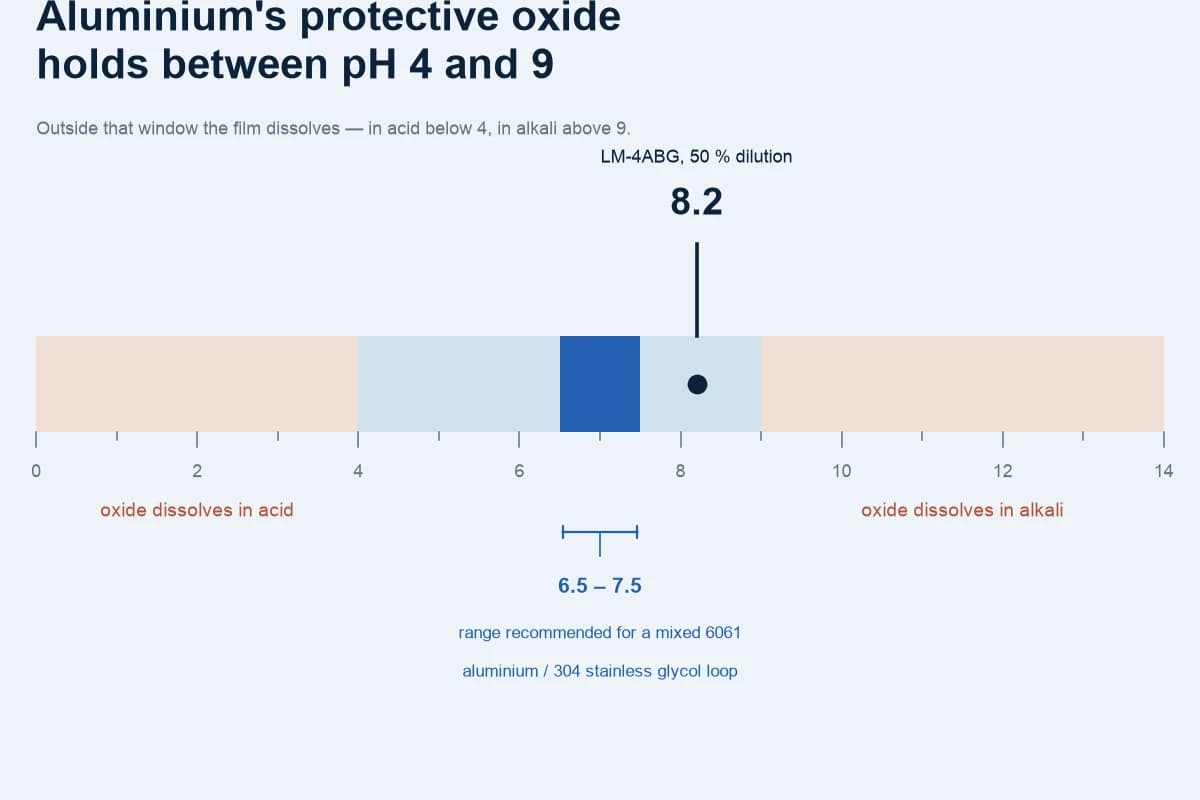
What does corrosion protection actually mean for a secondary coolant?
Measured weight-loss data from the Institute of Metals shows how these fluids perform against glycol. See what it covers and how to specify with it.
THE SHORT ANSWER
What you need to know.
Three kinds of corrosion evidence are available, and they answer different questions: measured weight-loss data from an immersion test, a three-year comparative test across steel, copper and aluminium, and per-model adaptive-metals lists. The measured data is real and usable — but it covers specific metals at specific concentrations over specific durations, so it shortlists rather than certifies. A defensible specification takes the measured result, names your own wetted materials and concentration, and asks for the test that closes the gap.
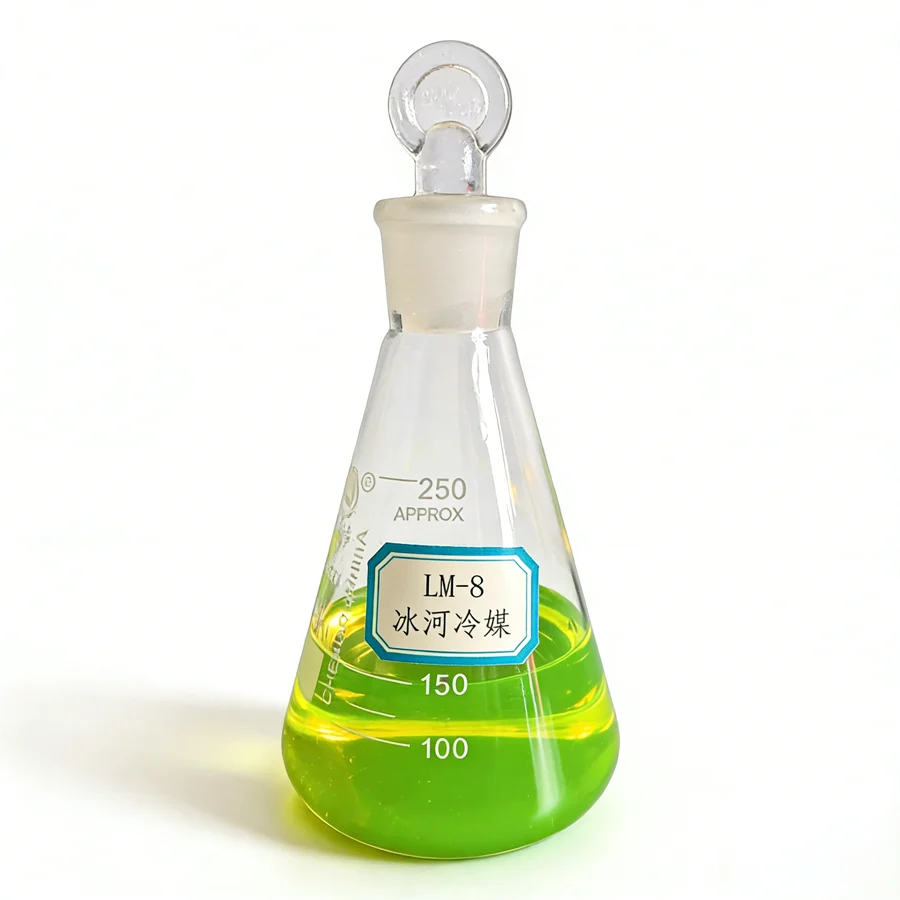
- The 168-hour weight-loss test is measured data, not an adjective — it compares ethylene glycol against LM-1 and LM-4 on A3 steel.
- The three-year comparison is the strongest published evidence: 0.0002 g steel loss with LM-1 against 2.5 g in 25% alcohol.
- What is missing is a model-specific result on your metals at your concentration — that is still a document request, not a website claim.
The failure you cannot see in a datasheet
Corrosion rarely announces itself. It shows up as a pump losing head over a season, a heat-exchanger approach temperature drifting upward, or a rust-coloured weep at a threaded joint. By the time it is visible, the fluid specification has usually been in service for years.
That delay is why corrosion claims deserve scrutiny — but it is also why measured data is worth more than most specifications give it credit for. Three distinct kinds of corrosion evidence are available, and the useful work is knowing which one answers which question.
Three kinds of evidence, three different questions
Corrosion information is presented at three levels:
| Level | What it is | What it answers |
|---|---|---|
| Measured immersion test | Weight loss in mg/cm² over 168 hours on A3 (Q235) steel | Does the inhibitor package work on carbon steel, and how does it compare with glycol? |
| Three-year comparison | Weight loss for steel, copper and aluminium in three solutions, 1997–2000 | Does the protection hold over a service timescale, across several metals? |
| Adaptive-metals list | Per-model intended metal coverage | Which model is meant for my material set? |
The mistake to avoid is treating these as interchangeable — or, in the other direction, assuming none of them exists.
The measured data: A3 steel over 168 hours
A quantitative immersion test reports weight losses for A3 (Q235) steel immersed in ethylene glycol, the alcohol-based LM-1 and the glycol-type LM-4, tested by the Institute of Metals, Chinese Academy of Sciences. The values are in mg/cm²:
| Time (h) | Ethylene glycol | LM-1 | LM-4 |
|---|---|---|---|
| 0 | 0 | 0 | 0 |
| 27 | 0.06222 | 0.00278 | 0.00017 |
| 49 | 0.14056 | 0.02444 | 0.02000 |
| 73 | 0.20056 | −0.00167 | 0 |
| 107 | 0.30667 | −0.00483 | −0.00683 |
| 142 | 0.41778 | −0.01017 | −0.01037 |
| 168 | 0.48778 | 0.01556 | 0.01833 |
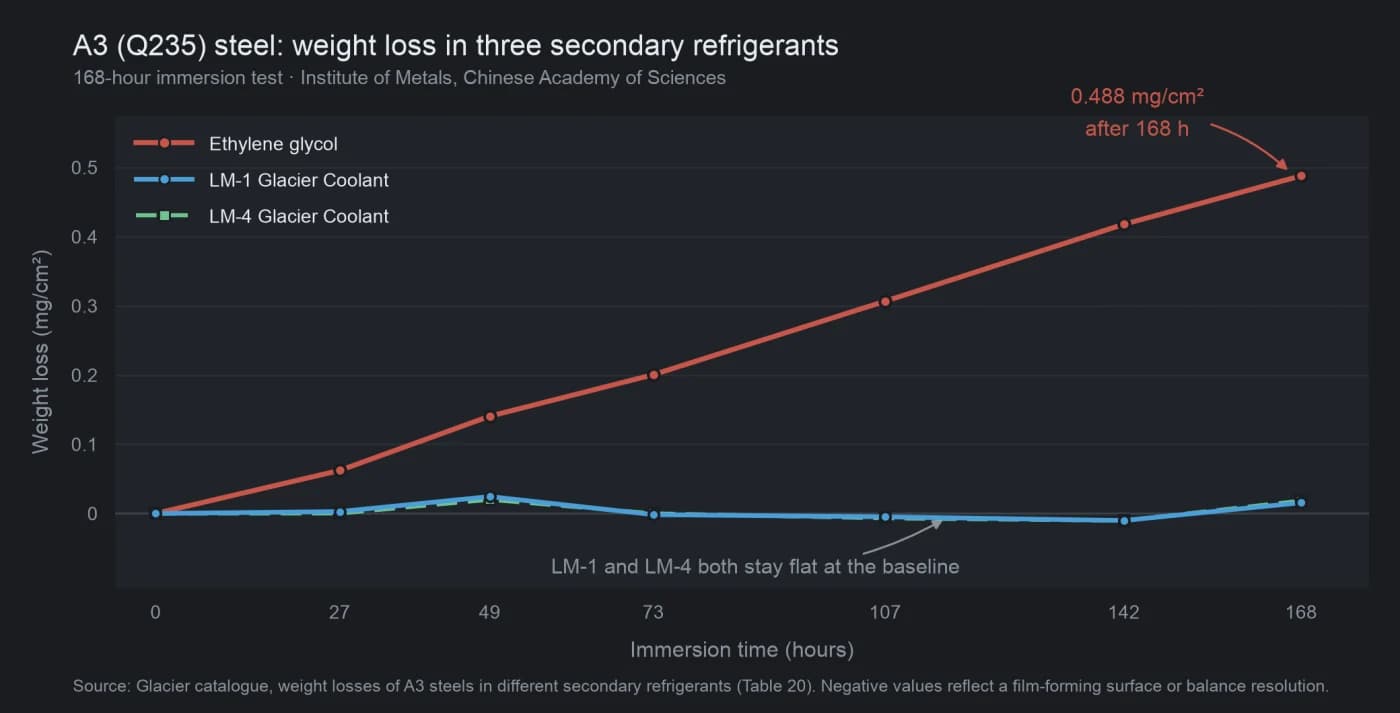
Three things are worth reading out of this table.
The comparison is against a reference, not a vacuum. Ethylene glycol climbs steadily to 0.488 mg/cm² over the week. The two Glacier fluids stay essentially flat. A test that only reported "our fluid shows low corrosion" would tell you nothing; comparing against the incumbent is what makes the number interpretable.
The negative values are not errors. LM-1 records −0.00167, −0.00483 and −0.01017 mg/cm² at 73, 107 and 142 hours; LM-4 records −0.00683 and −0.01037. In a weighed-coupon test this typically means the coupon ended marginally heavier than it started, or the change sits inside the balance's resolution — consistent with an inhibitor film forming on the surface. The signal is the flat trend, not the sign of any single reading.
The final jump is within noise. Both fluids rise slightly at 168 hours. Against ethylene glycol's 0.488, a figure of 0.019 is still a rounding error in service terms. Read the shape of the curve, not the last decimal.
The three-year comparison: the strongest published evidence
A longer test ran for three years: A3 (Q235) carbon steel, copper and aluminium coupons 4 mm thick, immersed at room temperature from February 1997 to February 2000 in 25% LM-1, 25% alcohol and tap water. Steel weight loss after three years:
| Solution | Steel weight loss (g) | Corrosion rate |
|---|---|---|
| 25% LM-1 Glacier Coolant | 0.0002 | 0.0007% |
| 25% alcohol | 2.5004 | 8.38% |
| Tap water | 2.5269 | 8.55% |
Copper and aluminium follow the same pattern: zero weight loss with LM-1, and measurable loss in both of the other solutions after the first month.
This is a genuinely strong dataset for a product range. A three-year duration addresses the timescale objection that a one-week test cannot, and the inclusion of copper and aluminium covers three of the four metals that dominate most industrial circuits. The near-total absence of steel loss over three years is the single most quotable figure in the document.
It is also worth noting what it is not: three years at room temperature, in three specific solutions, does not describe a chilled loop at −30 °C with fluctuating concentration and make-up water.
What the adaptive-metals list adds — and what it cannot
Separately from the tests, each model carries a list of intended metals. In the LM-4 series:
| Model | Temperature range | Adaptive metals listed |
|---|---|---|
| LM-4 | −35 to +50 °C | Stainless steel, carbon steel, copper |
| LM-4L | −35 to +50 °C | Stainless steel, carbon steel, copper, aluminium |
| LM-4G | −35 to +150 °C | Stainless steel, carbon steel, copper |
| LM-4D | −35 to +100 °C | Stainless steel, carbon steel, copper, aluminium |
This is a selection aid, not a test result. It tells you which model the manufacturer intends for a given metal set — note that LM-4L exists specifically as the aluminium-compatible variant, and that the salt-based LM-8 family splits its aluminium coverage across L and GL variants rather than offering it family-wide.
Use it to pick the model. Do not use it in place of a test result on a metal the published test did not cover.
The gaps the tests leave
Being precise about this matters, because the work of specification starts where the test results stop.
- A3 (Q235) steel is one grade. Your circuit may use 304 or 316L stainless, or an aluminium alloy. The three-year test covers steel, copper and aluminium as classes, not specific grades.
- The results are at stated concentrations — undiluted for the 168-hour test, 25% for the three-year test. A result at 25% does not transfer to 40% or 50%.
- Neither test is ASTM D1384. That is the standard glassware method for engine coolants, and it is the one most often quoted across suppliers. Results from a bespoke method are informative but not directly comparable with a D1384 figure — a point that matters when you are shortlisting against another vendor.
- Temperature is ambient. No elevated-temperature data is published.
- Elastomers, gaskets, brazes and coatings are not in scope. In most plants these are where a compatibility surprise appears first.
The inhibitor range follows the same pattern — LMH for brine systems, the LMT series for circulating-water corrosion and scale control, and LMZ for alcohol-based coolants, and specifies replenishment regimes rather than one-time fills. That acknowledges that inhibitor concentration in an operating loop declines and must be maintained.
Concentration changes the answer
The published tests fix concentration. Your loop does not.
Corrosion-inhibitor packages are formulated for particular concentration windows. Run the fluid more dilute than intended and the inhibitor can be under-dosed for the wetted area it has to protect. Run it more concentrated and you may gain no protection while paying for it in viscosity — the dilution tables show viscosity climbing steeply as concentration rises, and the freezing point itself turns back above the optimum, as the concentration guide sets out.
The practical consequence: the 25% three-year result tells you little about the same product at 50%. When you compare candidates, the first question is not "which number is lower" but "at what concentration, on which metals, and in what test."
Two parameters you can measure yourself
Two indicators are within reach of any site, and they are how you check that the protection the test demonstrated is still present in service.
Conductivity. Rising conductivity can accompany inhibitor depletion and increased ionic content. It is why low-conductivity models exist at all — LM-4D and LM-4D-YE use non-ionic additives to reduce conductivity and raise resistance to electrochemical corrosion, and their conductivity thresholds are stated as a contact-for-adjustment trigger, not a pass mark.
pH. For these models, pH below a specified value should prompt contact for adjustment.
Both are useful because they are trends. A single reading inside range proves very little; four readings over a year that show a consistent direction tell you something real. The intervals and thresholds are model-specific — read them from the current TDS, and see the degradation guide and maintenance programme for how they fit into a schedule.
What to ask for when the tests are not enough
Test results shortlist. Your specification needs to certify. When you approach a supplier, the request that gets answered is the one that names conditions:
- Your wetted materials, by grade — not "stainless steel" but 304 and 316L; not "aluminium" but 3003 and 6061 if both are present.
- Your operating concentration and dilution water quality. Both affect inhibitor performance.
- A test method and a result — the published weight-loss data if it covers your metals, or ASTM D1384 / an agreed dynamic-loop method if it does not.
- An acceptance limit in mass change per coupon, not an adjective.
- Monitoring parameters, intervals and action thresholds — conductivity and pH at minimum.
- The current TDS and SDS for the exact model, plus any inhibitor top-up regime.
Points 3 and 4 are the ones most often left as adjectives, which is why they are the ones worth insisting on.
Where to take this next
The industrial-process guide sets out the application questions to bring, and you can request the current TDS, SDS and supporting test information for the exact model rather than a family.
Bring your wetted-material list, concentration and temperature window with the request. A request that names those three can be answered with data; a request that asks only whether the product "resists corrosion" cannot.
QUICK CLARIFICATIONS
Common questions.
Are there actual corrosion numbers, or only claims?
It publishes numbers. Table 20 gives weight losses in mg/cm² for A3 (Q235) steel in ethylene glycol, LM-1 and LM-4 over 168 hours, from a test by the Institute of Metals, Chinese Academy of Sciences. A separate three-year comparison reports weight loss for steel, copper and aluminium in 25% LM-1 against 25% alcohol and tap water. What you still need is a model-specific result across the metals in your own circuit — request that with the current technical data sheet.
Some weight-loss values in the table are negative. Is that an error?
Negative values appear at 73, 107 and 142 hours for the two Glacier fluids. In a weighed-coupon test this usually reflects measurement resolution combined with a small mass gain as an inhibitor film forms on the surface — the coupon ends marginally heavier than it started, or the change is within the balance's uncertainty. The useful signal is the flat trend against ethylene glycol's steady climb, not the individual sign of a single reading.
Can I use the 168-hour test as an acceptance criterion for my system?
Use it to shortlist, not to certify. The test is a defined laboratory immersion at a stated concentration, on one steel grade, for a week. It does not reproduce your temperature cycle, flow regime, water chemistry or the other metals in your circuit — and it is not ASTM D1384, so it will not be directly comparable with a supplier who quotes that method. Treat it as evidence that the inhibitor package works on carbon steel, then ask for the result on your metals.
Why are pH and conductivity checks required every three months for some models?
Both are indirect indicators of fluid condition. For the LM-4D and LM-4D-YE models, conductivity above a specified value, or pH below a specified value, should prompt contact for adjustment. Those thresholds are model-specific and belong in your current technical data sheet .
CHECK THE SOURCE
References & scope.
- Glacier catalogue — weight losses of A3 steel in different secondary refrigerants, 168-hour test (Table 20)
- Glacier catalogue — quantitative corrosion experiment, Institute of Metals, Chinese Academy of Sciences
- Glacier catalogue — three-year comparison of metal weight loss across secondary refrigerants
- Glacier catalogue — LM-4 series adaptive metals by model (Table 4)
Obtain the relevant TDS, SDS and technical approval before use.
How we prepare our content