Warm-water liquid cooling: what a 45 °C supply changes
Warm-water cooling lets a facility reject heat without mechanical chillers. See what that shift does to the fluid, the loop and the materials in it.
THE SHORT ANSWER
What you need to know.
Warm-water liquid cooling changes the loop's job. Instead of chilling the fluid and circulating it cold, the facility runs it warm enough that ambient air can reject the heat — removing mechanical chillers from the path. For the fluid, that shifts the requirement: freeze protection stops mattering, while stability, inhibitor behaviour and material compatibility at elevated temperature start to. The data-centre grades in the range, designated for 0 to +80 °C, already cover that window.
- A warm supply temperature lets dry coolers reject the heat, which takes mechanical chillers out of the normal operating path.
- Higher loop temperature raises corrosion kinetics and inhibitor consumption — the monitoring parameters matter more, not less.
- Freeze protection is no longer a design driver, so a fluid chosen for cold-weather margin may be the wrong choice.
The premise has changed
For most of the history of liquid cooling, the objective was to make the fluid cold. A chilled-water loop ran at 7 to 12 °C, the chiller ran more or less continuously, and the fluid's job was to be cold and to stay that way.
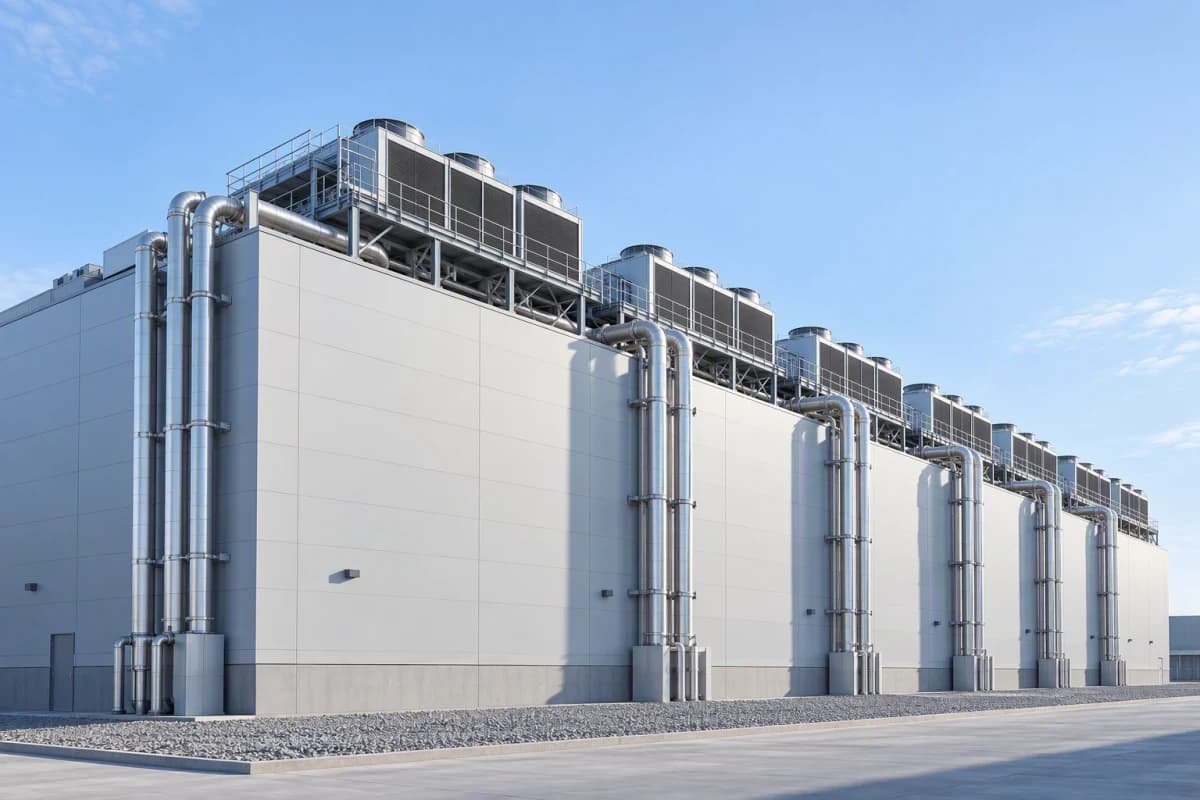
Warm-water cooling inverts the objective. The loop runs at a supply temperature around 40 to 45 °C — warm enough that the heat can be rejected to ambient air through a dry cooler rather than to a refrigeration circuit. The mechanical chiller does not disappear from the design; it stops being the thing that runs all year.
This has moved from a niche idea to a shipping specification. As of September 2026, the current generation of high-density compute hardware is specified for single-phase direct liquid cooling with a supply temperature in that range, and the density trajectory is what makes it necessary. Air cooling is usually optimised in the range of 8 to 12 kW per rack; a current high-density rack can draw well over 100 kW. The point at which direct-to-chip liquid cooling overtakes air cooling on ten-year total cost of ownership sits at roughly 30 kW per rack at an electricity price around $0.12/kWh — and that crossover is sensitive to the power price, so a site paying less needs a higher density before the economics turn.

What the fluid is now being asked to do
A warmer loop changes the requirement set, and the change is not symmetrical. Some things stop mattering; others start.
Freeze protection stops being the first question. This is the largest single shift. Coolant selection traditionally starts with the coldest temperature the loop will see, and works toward a concentration that protects it. In a loop that stays above ambient, that criterion is inert — and its usual cost, higher viscosity and more pumping power, is being paid for nothing.
Elevated-temperature stability starts mattering. Corrosion reactions accelerate as temperature rises, and oxidation does too. A fluid that would be stable for years at 20 °C is working harder at 60 °C. Inhibitor consumption is faster, and the fluid's own degradation rate is higher.
Elastomers and polymers need re-checking. A seal, gasket or hose qualified at 20 °C is not automatically qualified at 60 °C. Material compatibility lists are usually stated against a temperature range, and the range that applies is the one the component will actually see.
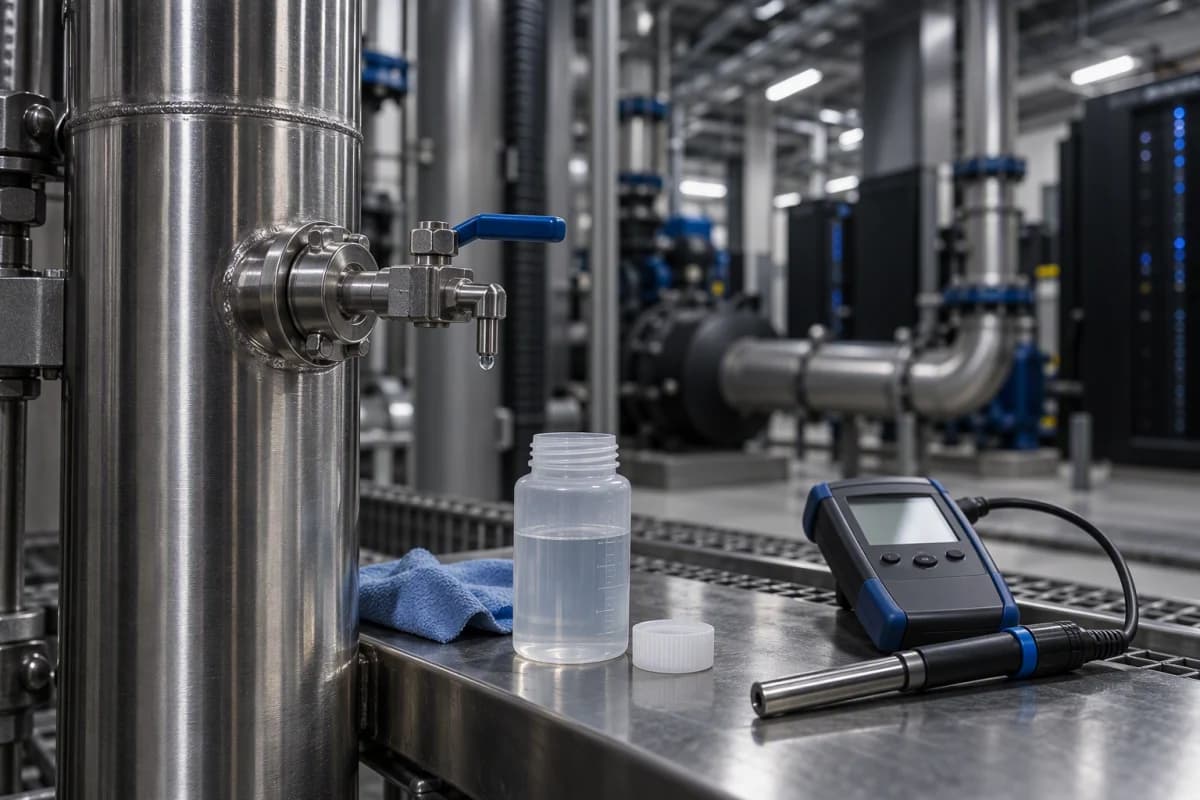
Conductivity and monitoring become more important, not less. If the loop is passing through cold plates beside live electronics, ionic content still matters — and it will drift faster at higher temperature. The three-month conductivity and pH check that applies to the low-conductivity data-centre grades is a starting interval, not a conclusion about your facility.
The grades that fit the window
As of September 2026, the data-centre designations in the range are specified across 0 to +80 °C, with the low-temperature variant reaching −3 °C — wide enough to cover warm-water operation with margin at both ends:
| Grade | Temperature range | Designation |
|---|---|---|
| LM-415L | 0 to +80 °C | data-centre circulation, aluminium-compatible |
| LM-420 | −3 to +80 °C | data-centre circulation |
Both are glycol-type (modified-diol) formulations. The difference between them is in the material compatibility and the low end, not the top: LM-415L is the variant that additionally covers aluminium. That distinction matters in a cold-plate loop because cold plates and their fittings are frequently aluminium, and an aluminium-compatible designation is not something to assume across a family — see indirect liquid cooling versus immersion for how the architecture narrows the shortlist.
What to specify for a warm loop
The specification changes shape rather than shrinking. Five items carry most of the weight:
- The full temperature window, including the warmest condition the fluid will see — which in a heat-reuse design may be higher than the supply temperature by design.
- The wetted materials at the top of that window, not at ambient. Cold plates, fittings, seals, hoses and any brazed joints.
- The monitoring parameters and interval, given that inhibitor depletion runs faster when the loop is warm.
- The make-up water and top-up policy, because the same ionic-content argument applies as in any low-conductivity loop — see what water to dilute coolant with.
- The standby and outage case. A warm loop that is shut down in a cold climate or drained for maintenance sees temperatures the operating case never produces.
Getting from a supply temperature to a fluid
The supply temperature is set by the compute hardware and the heat-rejection strategy, not by the fluid. What the fluid has to do is operate reliably across the window those two define, without corroding the materials it touches and without depositing anything in the passages it has to pass through.
That is a narrower question than it first appears, and it is answerable from the equipment vendor's requirement plus a fluid that is designated across the range. What it is not answerable from is a coolant chosen on a freeze-protection basis and assumed to be fine because the loop is warmer than that. Bring the equipment specification, the wetted-material list and the warmest condition the loop will see to your supplier — the answer is a model designation, a concentration and a monitoring interval for that specific combination.
QUICK CLARIFICATIONS
Common questions.
Why would a warmer fluid be better than a colder one?
Because the cold has to be produced somewhere, and producing it is the expensive part. A loop running at 40 to 45 °C can reject its heat to ambient air through a dry cooler for much of the year, which removes mechanical refrigeration from the normal operating path. A loop running at 15 to 20 °C needs a chiller running continuously. The warmer loop moves less heat per litre, so it needs more flow — but it avoids the largest single energy consumer in the plant.
Does a warm loop still need freeze protection?
Not for normal operation. That matters because freeze protection is usually the first criterion applied when choosing a coolant, and it pushes the selection toward higher glycol concentrations, which raise viscosity and pumping demand. If the loop never goes cold, that margin is being paid for and not used. The exception is any part of the circuit exposed to ambient in a cold climate, or a standby loop that can sit idle in winter — those still need an answer.
What changes in the fluid at higher temperature?
Several things move in the same direction. Corrosion reactions accelerate with temperature, so the inhibitor package works harder. Oxidation rates rise, which is why elevated-temperature service life is usually shorter than the same fluid would give in a cold loop. Elastomer and polymer properties shift, so seals and hoses rated at 20 °C may not be rated at 60 °C. None of that rules out warm-water operation — it changes which properties the specification has to pin down.
Can I run a single fluid across both a cold and a warm loop?
Only if the specification covers the full span and the material compatibility is confirmed at both ends. Data-centre grades are designated across 0 to +80 °C, which is wide enough for most warm-water duty, but a model chosen for one part of the range is not automatically approved across all of it. Confirm the exact model against the actual maximum and minimum the circuit will see, including standby and outage conditions.
CHECK THE SOURCE
References & scope.
- Glacier catalogue — LM-4 series models designated for data centres, temperature ranges (Table 4)
- Glacier catalogue — LM-4D conductivity, pH and three-month test interval (printed page 13)
- Network World — why AI rack densities make liquid cooling non-negotiable, including the 45 °C warm-water specification
- Mordor Intelligence — data centre liquid cooling market size and direct-to-chip growth
Obtain the relevant TDS, SDS and technical approval before use.
How we prepare our content